
New-vehicle affordability was essentially unchanged in December, according to the latest Cox Automotive/Moody’s Analytics Vehicle Affordability Index. Strong wage growth offset higher interest rates and higher transaction prices.
The estimated average auto loan rate was down 31 basis points year over year but increased 11 basis points for the month to 9.62%1. The average new-vehicle price increased 0.8% for the month to $50,326, according to Kelley Blue Book’s December average transaction price report. Income growth remained strong at 3.5% year over year.
The typical monthly payment was up 0.1% year over year and increased 0.3% for the month to $767, remaining below the December 2022 peak of $795. The number of weeks of median income needed to purchase the average new vehicle was essentially unchanged at 36.22 from 36.24 in November.
Cox Automotive/Moody’s Analytics Vehicle Affordability Index
December 2025
Weeks of Income Needed to Purchase a New Light Vehicle
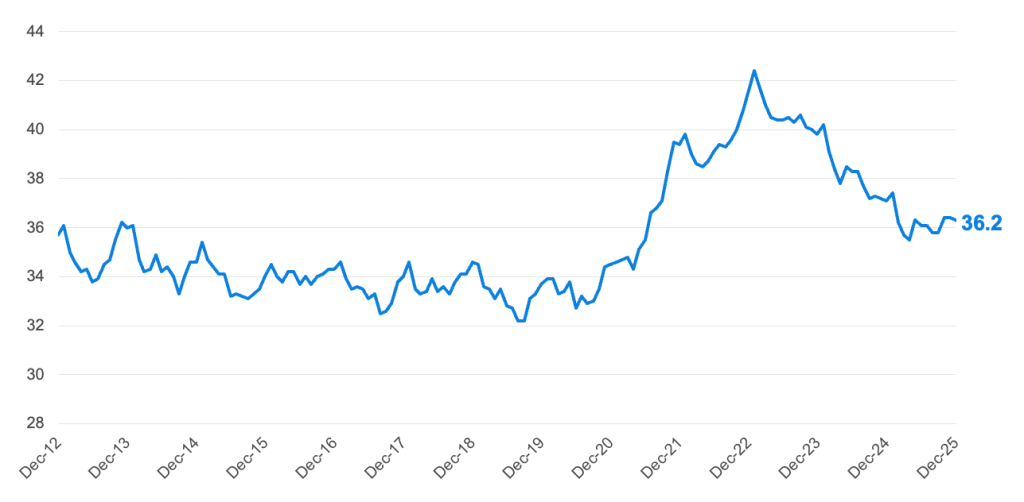
New-vehicle affordability in December was narrowly better than a year ago, even though prices were 0.7% higher because interest rates were lower and incomes were higher. Incentives were 17.4% lower than a year ago. New-vehicle affordability improved by 3.2% compared to a year ago, when it took 37.4 weeks of median income to purchase the average new vehicle.
Click here for the full methodology for the Cox Automotive/Moody’s Analytics Vehicle Affordability Index.
The next update of the Cox Automotive/Moody’s Analytics Vehicle Affordability Index will be published on Feb. 16, 2026.
1 The index input of the average interest rate paid by consumers is calculated to reflect a 72-month, fixed-rate loan. For the latest Dealertrack estimated volume-weighted average new loan rate, visit the Auto Market Snapshot.
The Cox Automotive/Moody’s Analytics Vehicle Affordability Index (VAI) is updated monthly using the latest data from government and industry sources, including key pricing data from Kelley Blue Book, a Cox Automotive brand. This important industry measure will be released at mid-month to indicate if the prices paid for new vehicles are moving out of consumers’ financial reach or becoming more affordable over time.