New-vehicle inventory increased again in October, giving shoppers more choices as the market moved further into the fourth quarter. According to Cox Automotive’s analysis of vAuto Live Market View data, available inventory rose 4.2% from September to 2.92 million units. Days’ supply increased to 87 days, up from 83 days in September but below the roughly 90-day level recorded a year earlier.
2.92M
Available Units
87
Days’ Supply
$50,498
Average Listing Price
October was the second consecutive month of inventory growth. Even so, available inventory remained 2.9% below October 2025. The daily sales pace was little changed from both September and a year ago, indicating that October’s increase in days’ supply primarily reflected more inventory rather than a sharp slowdown in demand.
Inventory Grows While the Sales Pace Holds Steady
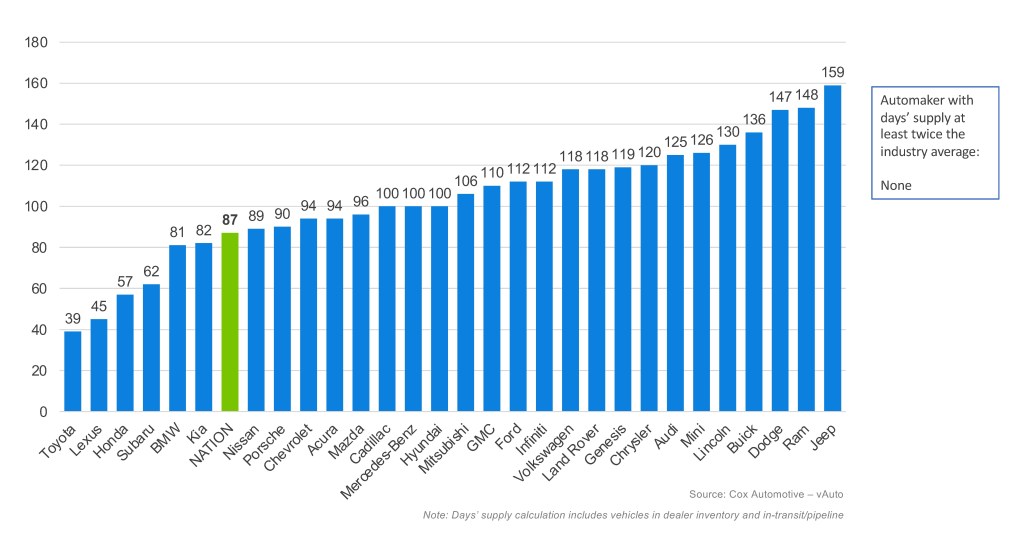
Toyota again had the leanest inventory among major brands, with 39 days’ supply in October. Lexus had 45 days, Honda had 57 days and Subaru had 62 days, all well below the national average.
Several domestic brands had substantially more supply. Jeep had 159 days’ supply, Ram had 148 days and Dodge had 147 days. Buick had 136 days, while Ford had 112 days and GMC had 110 days. Chevrolet was closer to the national average at 94 days.
The divide was also evident among high-volume models. Toyota’s Grand Highlander had 22 days, the RAV4 had 24 days’ supply, and the Camry had 28 days. Honda’s CR-V had 43 days. By comparison, the Jeep Grand Cherokee had 149 days’ supply and the Wrangler had 155 days. Ford’s F-150 and Chevrolet’s Silverado 1500, the most popular full-size pickup trucks, which routinely carry higher inventory levels, had 93 and 99 days, respectively.
October Days’ Supply of Inventory by Brand
Model-Year 2027 Supply Expands but Still Lags Last Year
The 2027 model-year changeover gained momentum in October. Next-model-year vehicles (MY2027 in this case) accounted for 32% of available inventory, up from 22.4% in September.
Even with that progress, the transition remained well behind last year. At the end of October 2025, next-model-year vehicles represented 49% of available supply, 17 percentage points more than this year’s share.
The rollout also varied widely among major brands: Next-model-year vehicles accounted for 58.1% of Kia inventory and 43.6% of Honda inventory, compared with 25.7% at Ford and 17% at Toyota.
At the model level, the transition was nearly complete for some popular vehicles: Next-model-year vehicles represented 99.9% of Kia Telluride inventory, 98.7% of Honda HR-V inventory and 93.5% of Chevrolet Equinox inventory.
Listing Prices Rise Above $50,000
The average new-vehicle listing price increased to $50,498 in October, up 1.7% from September and 2.7% from a year earlier. The October measure was the highest monthly average in the dataset. Listing prices reflect advertised prices, not transaction prices.
Vehicles priced at $50,000 or less made up about 50% of available inventory. The $30,000-and-under band had 80 days’ supply, while the $30,000-to-$40,000 band had 74 days and the $40,000-to-$50,000 range had 78 days’ supply. All were below the national average, although the mid-priced vehicles, not the most affordable, had tighter inventory levels in October.
Supply was generally higher at more expensive price points. Vehicles priced from $50,000 to $60,000 had 93 days, and those from $60,000 to $80,000 had 106 days. Above $80,000, days’ supply was estimated at 110 days. Roughly 27% of new retail inventory is priced above $60,000.
Affordability remains a challenge, but lower-priced vehicles are not uniformly scarce. Among models with average listing prices below $40,000, supply ranged from the Toyota Corolla at 36 days’ supply and the Honda CR-V at 43 days, while the Ford Bronco Sport, Jeep Compass, and Volkswagen Taos, all affordable options, had days’ supply at more than twice the industry average.
The Bottom Line
October brought more new vehicles into the market, while the daily sales pace – a measure of demand – held relatively steady. The additional inventory could place downward pressure on price, but the national supply remained below last year’s level and masked wide differences by brand, model and price band. For shoppers and dealers, more overall choice does not mean equal availability. Supply varies widely across the retail market, including among lower-priced vehicles.
View Historical New Vehicle Inventory reports.