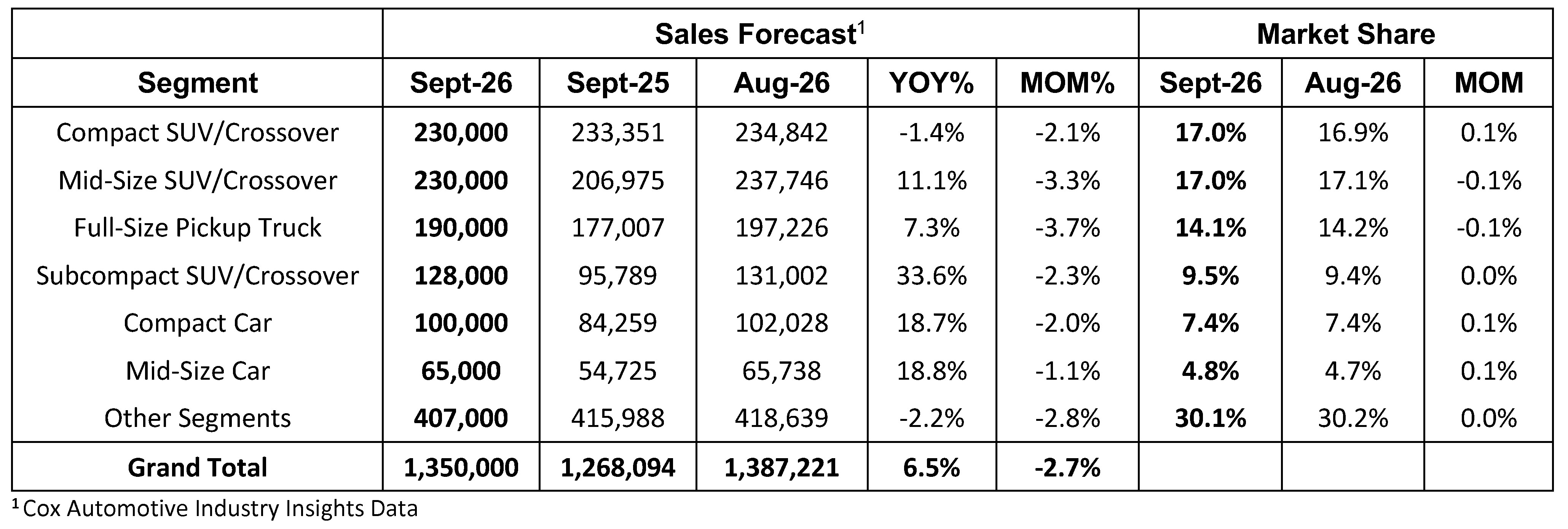
ATLANTA, Sept. 24, 2026 – September new-vehicle sales are expected to finish slightly below August levels but remain on the strong trajectory seen for most of the year. The seasonally adjusted annual rate, or SAAR, is expected to finish near 16.3 million, down from last September’s 16.6 million rate and down from August’s surprisingly strong 16.8 million pace.
September sales volume is expected to increase 6.5% from a year ago but decline 2.7% from August. Seasonal factors make month-to-month comparisons challenging. September has 25 selling days, one more than a year ago but one fewer than August. Comparisons are also affected by Labor Day timing, as the holiday was in September this year after being included in August sales last year.
According to Charlie Chesbrough, senior economist at Cox Automotive: “September new-vehicle sales should maintain the path the market has been on since March, which is a low-mid 16 million pace. Strong fleet sales, wealthier vehicle buyers, and more access to credit are all keeping this market relatively strong in the face of many headwinds. High inflation and historically low consumer confidence have not discouraged buyers as much as might be expected. New-vehicle buyers today are more affluent, so they may not be as impacted by inflationary pressures as other consumers.”
September 2026 New-Vehicle Sales Forecast
Q3 and Year-to-Date 2026 New-Vehicle Sales Forecast
General Motors is expected to remain the top-selling automaker in both the third quarter and year to date, although its sales and market share have softened compared with a year ago, reflecting broader challenges across its lineup. Toyota is forecast to post year-over-year growth in Q3 and continues to close the gap with GM, aided by gains in market share despite ongoing supply constraints for key models. Hyundai Motor Group is also expected to deliver another strong quarter, with sales rising from both a year ago and the prior quarter and ahead of Ford Motor Company.
Q3 2026 New-Vehicle Sales Forecast
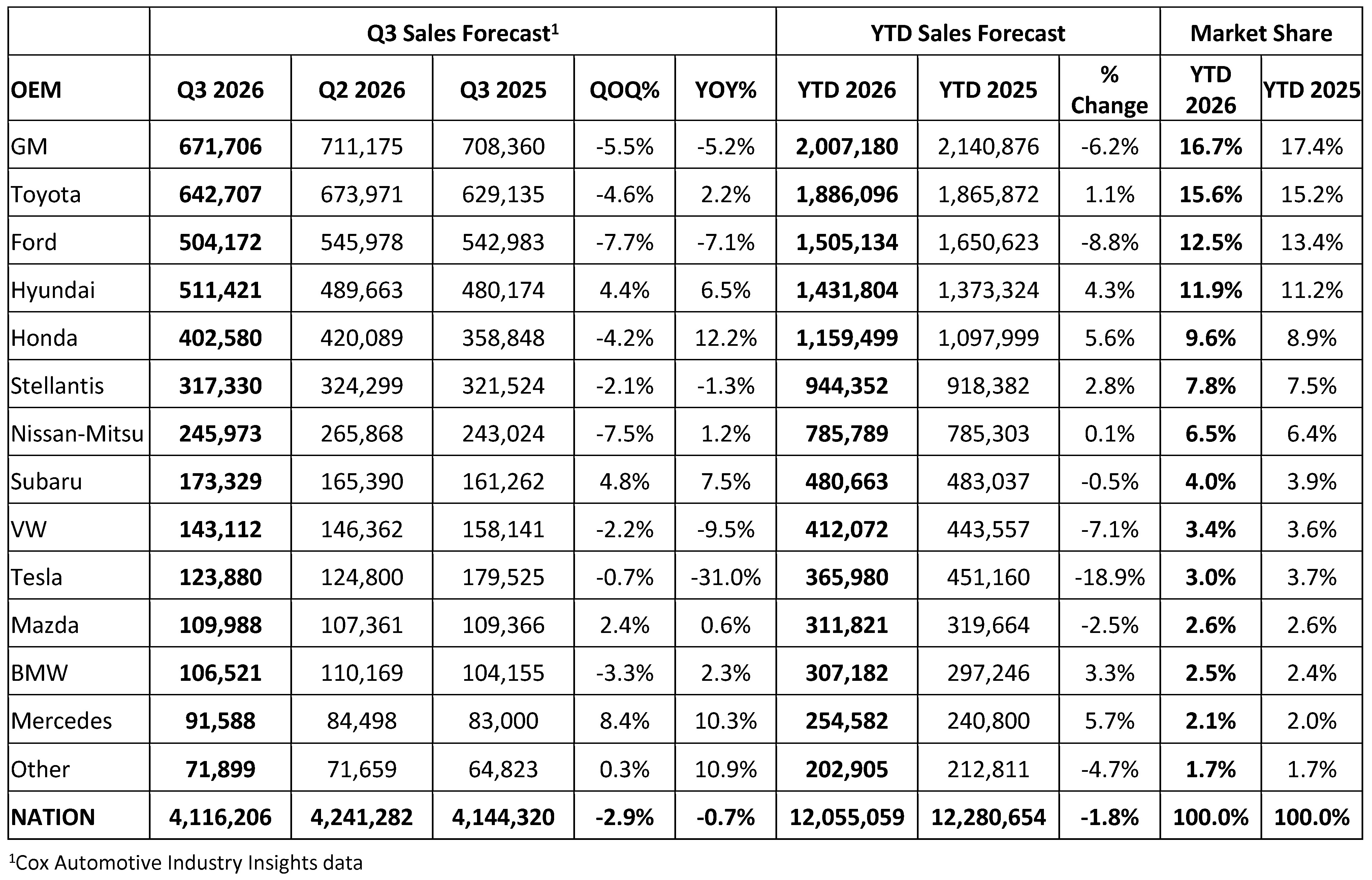
“The broader market story continues to be the growing and mostly on the strength of Asian automakers,” noted Chesbrough. “Asian brands are expected to account for more than half of U.S. new-vehicle sales for a second consecutive quarter, approaching record-high market share levels. At the same time, brands from the traditional Detroit 3 are forecast to fall to just over 36% market share, the lowest level on record. With consumers continuing to migrate toward hybrid vehicles and passenger cars, segments where Asian manufacturers maintain significant advantages, the shift in market share is expected to continue through the remainder of the year.”
Full-Year 2026 Sales Forecasts
Cox Automotive has raised its full-year 2026 new-vehicle sales forecast to 16.1 million units from 15.8 million, reflecting a market that has proven more resilient than expected despite higher fuel prices, elevated interest rates and ongoing economic uncertainty. Strong summer sales performance, improving credit availability and sustained consumer demand prompted the upward revision.
Forecasts for both new retail sales and fleet sales were increased, with retail now expected to reach 13.1 million units and fleet projected at 3 million units. While leasing activity remains under pressure from the loss of the federal EV tax credit, lease volume is forecast at 3 million units, and lease penetration has been lowered to 23%.
In the used-vehicle market, Cox Automotive expects 20.5 million used retail sales and 38.5 million total used-vehicle sales in 2026, while pre-owned sales are forecast at 2.6 million units. The 2026 forecast for retail sales and total sales has been increased, but total used-vehicle sales in 2026 are still forecast to finish slightly below 2025 levels.
“The biggest change in this update is that we have more confidence in demand than we did three months ago,” said Jeremy Robb, chief economist at Cox Automotive. “The market has consistently outperformed expectations despite higher fuel prices, elevated interest rates and softer consumer sentiment. As a result, we raised our full-year sales forecast and increased our outlook for both retail and fleet sales. While affordability challenges remain and the industry is still adjusting to the loss of federal EV incentives, vehicle demand has proven remarkably durable heading into the fourth quarter.”
Media Contacts:
Mark Schirmer
734 883 6346
mark.schirmer@coxautoinc.com
Dara Hailes
470 658 0656
dara.hailes@coxautoinc.com