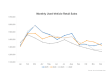
There was a lot of economic and automotive data released last week, and this edition of the Auto Market Weekly Summary includes updates on credit conditions, inflation trends, vehicle affordability metrics and housing market sentiment. All these data components help frame the economic environment dealers are navigating as we move toward NADA 2026.
The Bottom Line Up Front
Credit conditions delivered the brightest signal last week, with auto credit availability reaching its highest level in over two years. The Dealertrack Credit Availability Index, climbing to 99.6, caps a strong year of improving access, driven by compressed yield spreads and expanded subprime lending. This easing credit environment gives dealers an important tool that complements expected higher tax refunds as we head into spring, even as worries about affordability and the overall health of the consumer persist.
Elsewhere, data suggest that the economy continues along its dismal journey without making much progress on core metrics. Inflation remains stubbornly above the Fed’s 2% target, with shelter costs re-accelerating and energy prices rising despite relief at the pump. Vehicle affordability held steady in December only because wage growth offset higher prices and rates – a delicate balance that requires all three variables to cooperate. Builder sentiment retreated to start 2026, falling to 37 as affordability pressures intensify across lower and mid-range housing segments, with 40% of builders now cutting prices. We can’t underestimate the importance of a strong housing market to the economy: it’s highly correlated with vehicle sales.
The through-line across these indicators shows an affordability strain with little sign of quick resolution. Mortgage rates have improved to just above 6%, and the recent announcement that Fannie and Freddie will further support the market may provide additional support. But with inflation proving sticky and the Fed signaling patience, dealers face an extended period of managing margin pressure while credit conditions – at least for now – remain accommodative.
Auto Credit Availability
Auto credit availability reached its highest level in over two years in December 2025, with the Dealertrack Credit Availability Index climbing to 99.6, just below its January 2019 baseline of 100. The improvement caps a strong year for credit access, with the full-year 2025 index averaging 97.3, up almost 4% from 2024.
- December gains were driven primarily by pricing, with yield spreads declining to 6.6% and approval rates rising to 73.7%. The decline in yield spreads signals lenders are more apt to pass along lower borrowing costs to consumers.
- Increased subprime lending accounted for over half of the full-year 2025 index improvement, as lenders expanded risk appetite and accommodated longer loan terms amid persistent affordability pressures.
- Banks posted the strongest year-over-year loosening among lender types (+9.3%), while franchise used (+6.7%) and non-captive new (+5.4%) led channel improvements.
Inflation Readings Indicate a Longer Path to Target
Last week, we received an update on inflation from the Consumer Price Index and the Producer Price Index. The December CPI update supports many economists’ views that inflation is expected to ease gradually over the course of 2026, while the most recent PPI data suggests companies are limiting how much higher import duties and costs they are passing through. Both readings suggest it will continue to take time to hit the Fed’s target rate of 2% annual inflation.
- CPI increased 0.3% in December compared to November, in line with expectations. However, Core CPI increased 0.2% month over month and less than expected. Overall, CPI increased 2.7% year-over-year and above the Fed’s target rate of 2%.
- While the price of gasoline has provided some relief to consumers over the last year, increases in electricity and natural gas more than offset that relief, causing the total energy component of CPI to rise 2.3% year over year.
- The shelter (home) cost component of CPI accelerated on a year-over-year basis this month to 3.2%, after declining 60 basis points (bps) in the previous report to a rise of 3.0%. Shelter is heavily weighted in the index, thus changes to the component are critical for the overall rate of inflation.
- The most recent producer price index was updated through November last week, showing that PPI increased 0.2% in the month compared to October levels. The index increased 3.0% on a year-over-year basis.
- November’s PPI increase was led by an increase in the index for final demand goods. Prices for final demand services were flat in November.
Vehicle Affordability Holds Steady
New-vehicle affordability remained steady in December, as wages grew 3.5% year over year and offset higher interest rates and transaction prices, according to the Cox Automotive/Moody’s Analytics Vehicle Affordability Index.
- The typical monthly payment rose marginally to $767, still below the December 2022 peak of $795. However, the weeks of income needed to purchase a new vehicle held flat at 36.2 weeks.
- Affordability was just marginally higher than in December 2024 despite higher prices, driven by lower rates and higher incomes.
- Incentives were 5% lower than a year ago, pushing the average transaction price almost 1% higher and pressuring affordability metrics.
NAHB Builder Sentiment Weakens to Start 2026
After modest improvements in late 2025, builder confidence retreated to start the new year as affordability pressures intensified.
As of Jan. 15, the 30-year fixed mortgage rate was down to 6.06% and lower by 79 bps year over year. The recent announcement of $200 billion in mortgage-backed securities purchases by Fannie Mae and Freddie Mac may provide additional support, though the NAHB noted the survey for the month was conducted before the news broke.
Builder confidence in the market for newly-built single-family homes fell two points to 37 in January and was weaker than expected, according to the NAHB/Wells Fargo Housing Market Index.
The decline reflects growing affordability concerns, particularly in lower and mid-range segments. Buyers are struggling with high home prices and elevated mortgage rates, with down payments presenting an acute challenge amid stretched price-to-income ratios.
All three index components were below the 50 breakeven mark that separates positive from negative sentiment, as builders continue to respond to market conditions: 40% reported cutting prices in January (averaging 6% reductions), while 65% offered sales incentives – the tenth consecutive month above 60%.