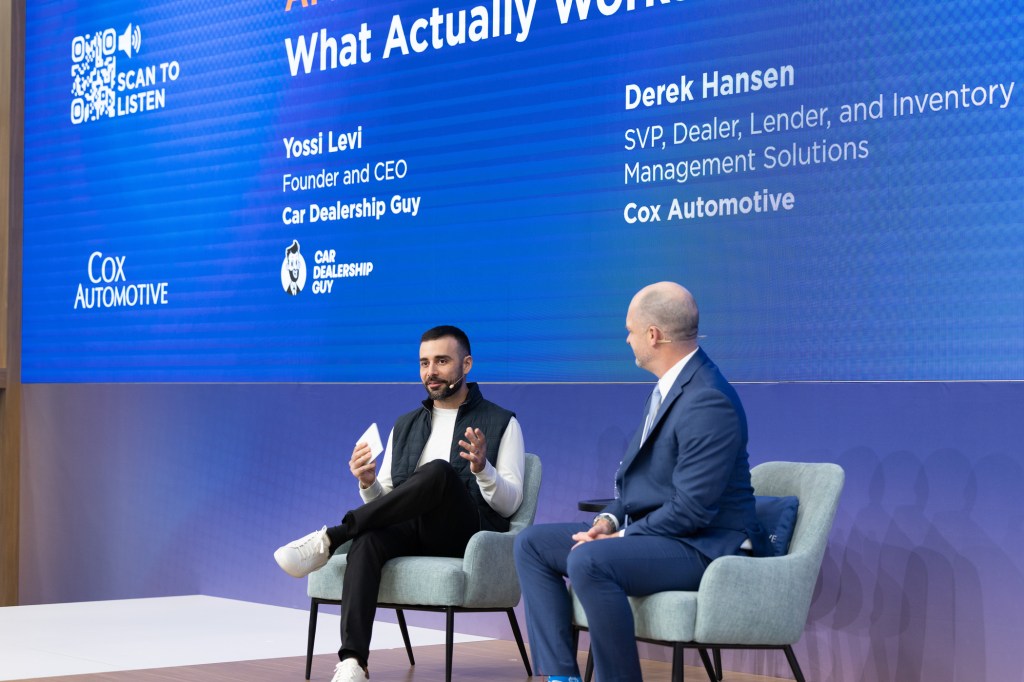
In a recent interview moderated by Yossi Levi, founder and CEO of Car Dealership Guy, Cox Automotive’s Derek Hansen, SVP of Dealer, Lender & Inventory Management, sat down to cut through the noise around AI in dealerships and focus on the tools and practices that are driving real results today.
The conversation began by outlining a foundational truth: AI is not magic. Hansen emphasized that “the quality of your data is critical to getting the insights you need out of AI to really continue to move your business forward… if you have skewed data or incomplete data, you’re going to get incomplete results.” Hansen’s perspective is backed by the understanding that impactful AI-enabled outcomes require a comprehensive view of the marketplace, including supply and demand trends, consumer search behavior, vehicle history, reconditioning costs, and a dealer’s own historical sales data. Without that breadth of data, implementing AI becomes a misinformed guessing game rather than a tool for intelligent decision-making.
Hansen then turned to acquisition, one of the more pressing challenges for dealers in today’s market. He outlined three areas where AI is making a measurable impact. First is inventory strategy. AI can identify gaps, analyze market velocity, and align sourcing decisions with real-time demand signals. Second is expanding acquisition channels beyond traditional trade-in and wholesale sources to include your service drive, private party sales, and Kelley Blue Book’s Instant Cash Offer. AI helps track performance across these channels and prioritizes the most profitable opportunities. Third is condition transparency. AI tools that scan vehicles and generate accurate reconditioning insights remove guesswork from appraisals, protecting front-end gross and increasing win rates.
On pricing, Hansen emphasized the impacts of AI on sales modeling. Because AI is able to ingest millions of VIN-level data points and sales data, it is able to instantly calculate the optimal price based on a dealer’s strategy, whether they prioritize gross or turn. Then, as trust builds, AI can begin executing pricing tasks autonomously with guardrails, leaving employees to focus on uniquely human tasks.
The main takeaway was clear: the future centers on agentic AI. Hansen closed by underscoring what makes that future possible: complete, high‑quality data, emphasizing that “you want to make sure you have all the data points of how [your customers are] searching…so that you’re in the best position for success.” As AI assistants increasingly advance in acquisition, pricing, and merchandising tasks, dealers who invest now in training these systems with comprehensive data will be best positioned to unlock new efficiencies and competitive advantage.