Ten years after Cox Automotive first studied consumer attitudes toward autonomous vehicles (AV), new research from the company finds that Americans are becoming more familiar with the technology and more likely to encounter it in everyday life. The research also finds that robotaxis are helping shift consumer attitudes, as the vast majority of robotaxi users noted the experience vastly improved their perceptions of autonomous vehicle technology.
A decade ago, assumptions surrounding autonomous vehicles and shared transportation services suggested the technology could ultimately render personal vehicle ownership obsolete. That prediction is proving slow to materialize, as the availability of vehicles with Level 3 autonomy is limited, and no Level 4 or Level 5 vehicles are available for retail sale. And yet, while traditional vehicle ownership remains firmly entrenched, research from Cox Automotive clearly shows that autonomous technology is showing early signs of real-world adoption.
“The auto industry has always had longer adoption curves for new technologies,” said Vanessa Ton, senior manager of Market and Customer Research at Cox Automotive. “Even hybrid vehicles, which have been available to U.S. consumers for more than 25 years, account for only about one in five new-vehicle sales today. For autonomous vehicles, safety concerns and high-profile incidents have slowed progress, but the growing acceptance of robotaxis seen in this year’s study indicates that attitudes are clearly evolving.”
The newly released 2026 Cox Automotive Autonomous Vehicle Study explores two aspects of the market’s autonomous future.
- How consumers feel about autonomous technology in vehicles they may own one day.
- How consumers view robotaxis and other autonomous ride-hailing services they may use without ever purchasing an AV.
The findings suggest consumers are increasingly open to autonomy, but need proof, firsthand experience, and, importantly, wider availability before fully embracing autonomous transportation.
Consumers Are Ready for More Automation, But Not Less Control
A decade ago, autonomous vehicles were largely hypothetical for most Americans. Today, familiarity with AVs has grown significantly, and consumers are beginning to form more informed opinions about the technology.
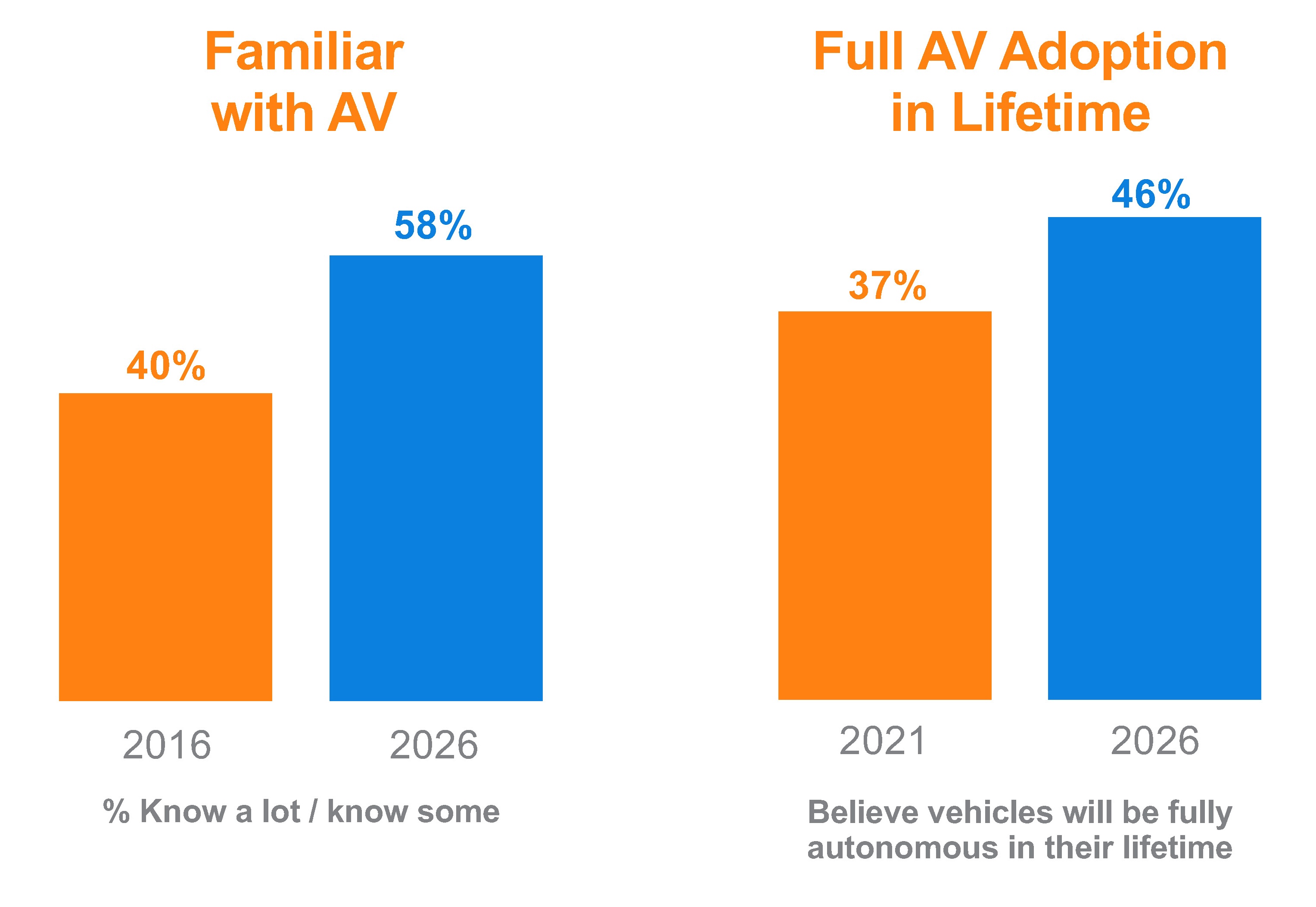
Consumer familiarity with autonomous vehicles increased from 40% in 2016 to 58% in 2026, while nearly half of consumers (46%) now believe vehicles will become fully autonomous at some point during their lifetime, up from 37% as recently as 2021.
Familiarity with Autonomous Vehicles and Full AV Adoption
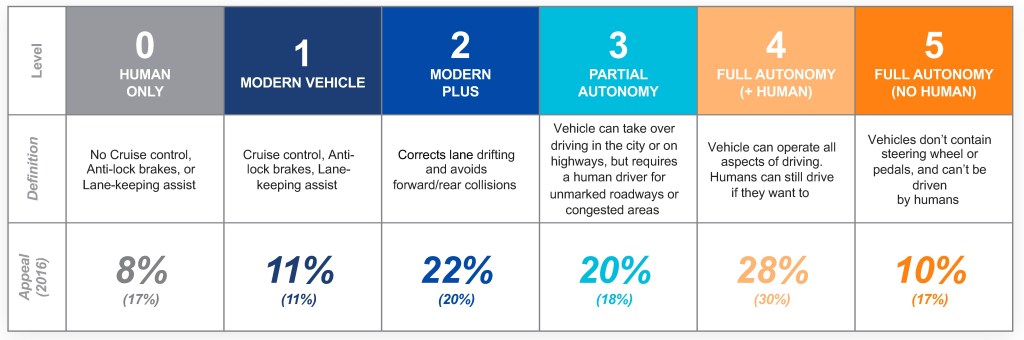
The study also found that consumers, when considering vehicle ownership, are most attracted to autonomy levels that preserve the option for human control. The most appealing level of autonomy continues to be Level 4 (full autonomy capability, with the option for a human to drive), selected by 28% of respondents, down from 30% a decade ago. Meanwhile, interest in fully driverless Level 5 vehicles declined notably from 17% in 2016 to 10% in 2026, suggesting that consumers have become less interested in permanently giving up control of the driving experience.
Levels of Autonomy and Consumer Appeal
As consumer perception is being formed, autonomous technology is already making its way into dealer showrooms and America’s garages. Ownership of Level 2 and Level 3 vehicles nearly tripled over the last decade, rising from 12% in 2016 to 34% today. In addition, 57% of consumers said they would choose a Level 3 or higher vehicle for their next purchase if all autonomy levels were available. Taken together, data suggest consumers are increasingly comfortable adopting advanced driver-assistance technologies, even as the appeal of owning a full, Level 5 autonomous vehicle has waned.
Robotaxis May Follow a Different Adoption Curve
If the ownership story is about maintaining some level of control, the robotaxi story is about the positive experience of giving it up. The new research from Cox Automotive found that consumers are often more willing to embrace Level 5 autonomy when they don’t have to buy the vehicle themselves.
Awareness of robotaxis has reached 70% nationally and 89% among residents of cities where autonomous services operate, although actual usage remains far lower at 18% nationally and 33% among AV-city residents.
Robotaxi availability is rapidly expanding in many cities. Market leader Waymo claims to now provide roughly 2 million robotaxi rides per month in the U.S. Research shows that 55% of Americans are open to using robotaxis, suggesting adoption is more constrained by availability than by interest.
Consumer Satisfaction with Robotaxi Experience and Change in AV Perception
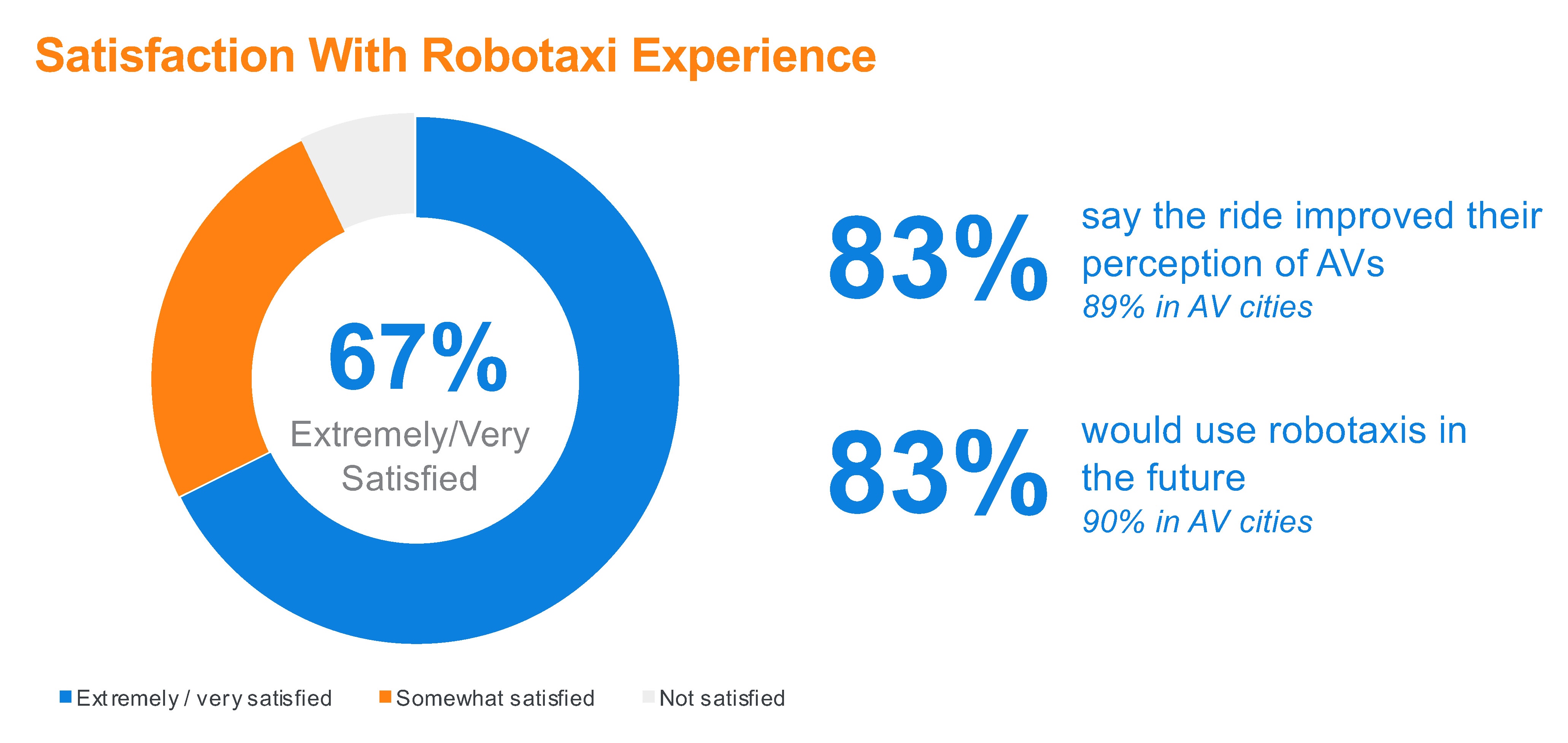
At the same time, the study found that 61% of non-users still cite discomfort with having no human driver as their primary barrier. The contrast between robotaxi users and non-users points to one of the study’s clearest conclusions: Experience overcomes skepticism. As robotaxi availability expands and more consumers gain firsthand experience, acceptance will likely increase further and interest in Level 4 and Level 5 technology will expand.
Download a copy of the full study.