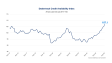
Updated, April 2, 2026: New-vehicle sales momentum improved in the final weeks of March, finishing stronger than Cox Automotive had forecasted. Early estimates suggest March new-vehicle sales will come in at approximately 1.4 million units, down nearly 12% year over year, a smaller decline than the roughly 14% drop outlined in the initial forecast. As a result, March’s seasonally adjusted annual rate (SAAR) is now estimated at 16.3 million, above Cox Automotive’s March forecast of 15.8 million.
The stronger-than-expected finish was driven in part by fleet sales that outperformed expectations, particularly from major Korean brands and Stellantis, based on early indications. While a significant year over year decline in March sales was expected given tough comparisons to 2025, sales held up better than anticipated as momentum carried through the latter part of the quarter. Consumer spending also appeared to remain resilient despite ongoing softness in consumer sentiment. In the first quarter, the new-vehicle sales pace finished at 15.6 million units, slightly above Cox Automotive’s 15.5 million forecast, a result of the stronger close to March.
Despite the Q1 upside, Cox Automotive is maintaining its full year 2026 sales forecast of approximately 15.8 million units. The outlook continues to reflect a relatively soft first half followed by steadier performance in the second half of the year, with full year new-vehicle sales still expected to finish below 2025 levels.
ATLANTA, Mar. 25, 2026 – The U.S. new-vehicle sales pace in March is forecast to finish essentially unchanged from February, according to Cox Automotive, the world’s largest automotive services and technology provider. Despite the added uncertainty of a war in the Middle East, March is expected to hold steady at a seasonally adjusted annual rate (SAAR) of approximately 15.8 million, a level mostly consistent with the final three months of 2025.
The sales pace in March is forecasted to be lower by nearly 12% year over year, but the annual decline is mostly reflective of a burst of pre-tariff buying that pulled demand forward a year ago. March 2025 delivered an elevated sale pace of 17.9 million, a four-year high. The new-vehicle market today is very different, weighed down by the ongoing affordability challenges and broad uncertainty in the economy.
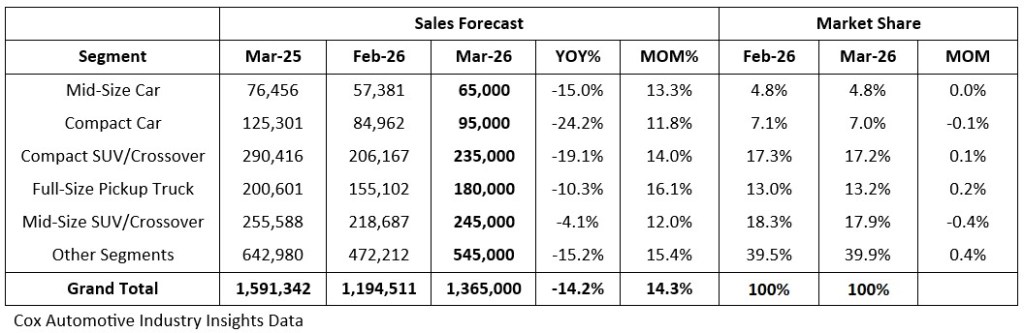
New-vehicle sales volume in March is forecast at 1.37 million units, down 14.2% from the tariff-driven surge seen in March 2025, but higher than February by 14.3%. March is traditionally a strong month for new-vehicle sales and often shows a volume increase from February.
“Sales are no longer swinging wildly month to month, but growth is also harder to come by,” said Charlie Chesbrough, senior economist at Cox Automotive. “Affordability remains the central challenge for the industry, and that is limiting the market’s ability to expand beyond the mid-15-million range.”
March 2026 New-Vehicles Sales Forecast
Q1 Reflects a Reset From 2025 Extremes
New-vehicle sales in early 2026 have remained relatively consistent with the pace seen in the final three months of 2025, holding steady in the upper-15-million range and below highs reached last spring. The sales pace in each month of Q1 was slower year over year, most notably in March. The sales pace suggests a smaller, slower-growth market constrained by uneven consumer demand and new challenges.
“After a year marked by policy-driven sales volatility, the new-vehicle market has settled into a slower rhythm in early 2026,” said Jeremy Robb, chief economist at Cox Automotive. “The pull-ahead demand created by last spring’s tariff announcements and, later, the loss of EV tax credits is now all firmly in the rearview mirror. While the stimulus of a good tax-return season is a positive, the new-vehicle market today is being shaped by higher vehicle prices, ongoing inflationary pressures, and still-elevated interest rates.”
Q1 2026 New-Vehicle Sales Forecast
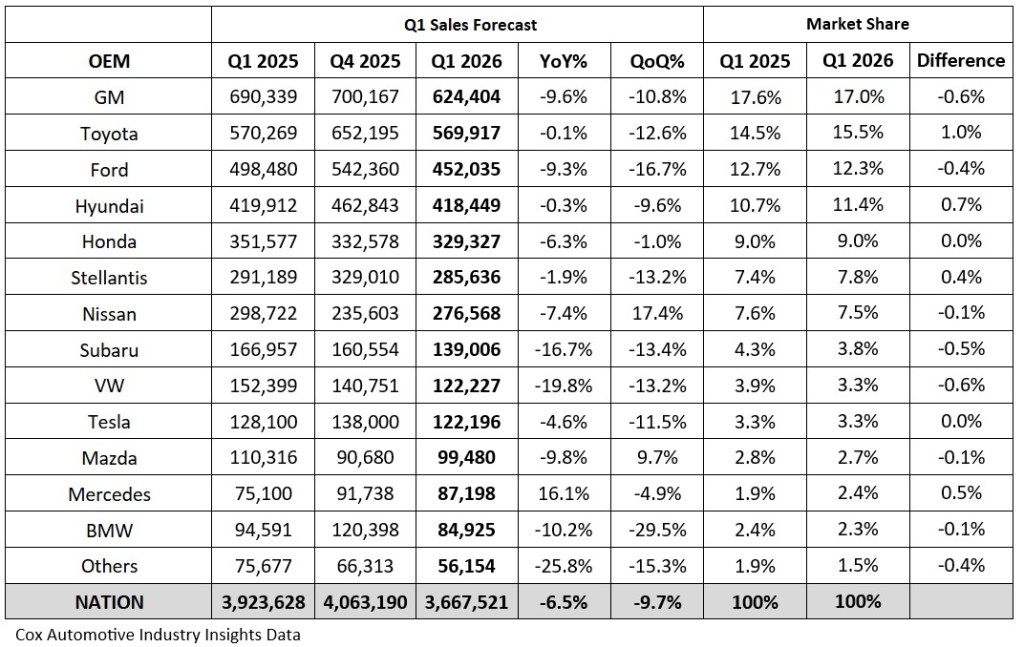
New-vehicle sales performance in Q1 has been uneven across different brands, models, and market segments. Sales of smaller vehicles — particularly compact cars and compact SUVs — have fallen more than the overall industry, reflecting weaker demand from lower-income buyers and the ongoing affordability pressures for mainstream shoppers. Sales of more expensive full-size trucks and SUVs also declined in Q1. Midsize segments, however, are forecast to see sales growth in Q1, driven by new product launches and, in some cases, buyers stepping down from higher price points. Toyota and Hyundai are expected to deliver solid share growth in Q1, as will Nissan, thanks to strong Rogue and Pathfinder sales. Stellantis is also forecast to deliver year over year share growth.
Electric vehicles, which surged briefly last year ahead of incentive changes, have seen softer demand in early 2026, as the loss of federal tax incentives continues to negatively impact the market. Despite rapidly increasing fuel prices, EV sales are forecast to be lower by 28% year over year in Q1. Sales of hybrid vehicles, however, thanks largely to Toyota and Honda, continue to demonstrate solid growth.
Cox Automotive expects the new-vehicle sales pace for the full year of 2026 to be 15.8 million, down about 2.6% from 2025, a forecast that remains unchanged from the beginning of the year. While the baseline outlook assumes current geopolitical tensions and oil-price volatility ease in the coming months, prolonged disruption could create additional downside risk for vehicle demand.
About Cox Automotive
Cox Automotive is the world’s largest automotive services and technology provider. Fueled by the largest breadth of first- and third-party data fed by 2.3 billion online interactions a year, Cox Automotive tailors leading solutions for car shoppers, auto manufacturers, dealers, lenders and fleets. The company has 29,000+ employees on five continents and a portfolio of industry-leading brands that include Autotrader®, Kelley Blue Book®, Manheim®, vAuto®, Dealertrack®, NextGear Capital™, CentralDispatch® and Cox Fleet®. Cox Automotive is a subsidiary of Cox Enterprises Inc., a privately owned, Atlanta-based company with $23 billion in annual revenue. Cox Automotive has been included on Glassdoor’s Best Companies in Tech & AI 2026 and Best Place to Work in 2026 lists. Visit coxautoinc.com or connect via @CoxAutomotive on X, CoxAutoInc on Facebook or Cox-Automotive-Inc on LinkedIn.
Media Contacts:
Mark Schirmer
734 883 6346
mark.schirmer@coxautoinc.com