New-vehicle inventory increased in September as the sales pace slowed from August, providing the market with more available supply heading into the final quarter of the year. According to Cox Automotive’s analysis of vAuto Live Market View data, inventory rose 4.5% during the month to 2.80 million units. Days’ supply increased to 82 days, up from 75 days in August but below the 87-day level recorded a year earlier.
2.80M
Available Units
82
Days’ Supply
$49,726
Average Listing Price
The September increase reversed three consecutive months of inventory declines. Even with the monthly gain, available inventory remained 1.9% below September 2025, while the daily sales pace was 4% higher than a year ago.
Inventory Recovers as the Sales Pace Eases
The new-vehicle daily sales rate was 34,300 units in September, down 3.4% from August and up 4% from September 2025. Implied sales totaled approximately 1.03 million vehicles during the month, down 6.5% from 1.10 million in August but up 4% year over year. Worth noting: September’s year-over-year volume growth looked stronger, partly due to the calendar. Labor Day sales fell into September’s reporting period this year but were captured in August last year. On a selling-day and seasonally adjusted basis, the market was considerably flatter.
With inventory growing and the sales pace moderating, days’ supply increased by approximately seven days. The market nevertheless remained tighter than it was a year earlier, reflecting both lower available inventory and stronger sales activity.
Inventory Strategies Continue to Vary Widely by Brand
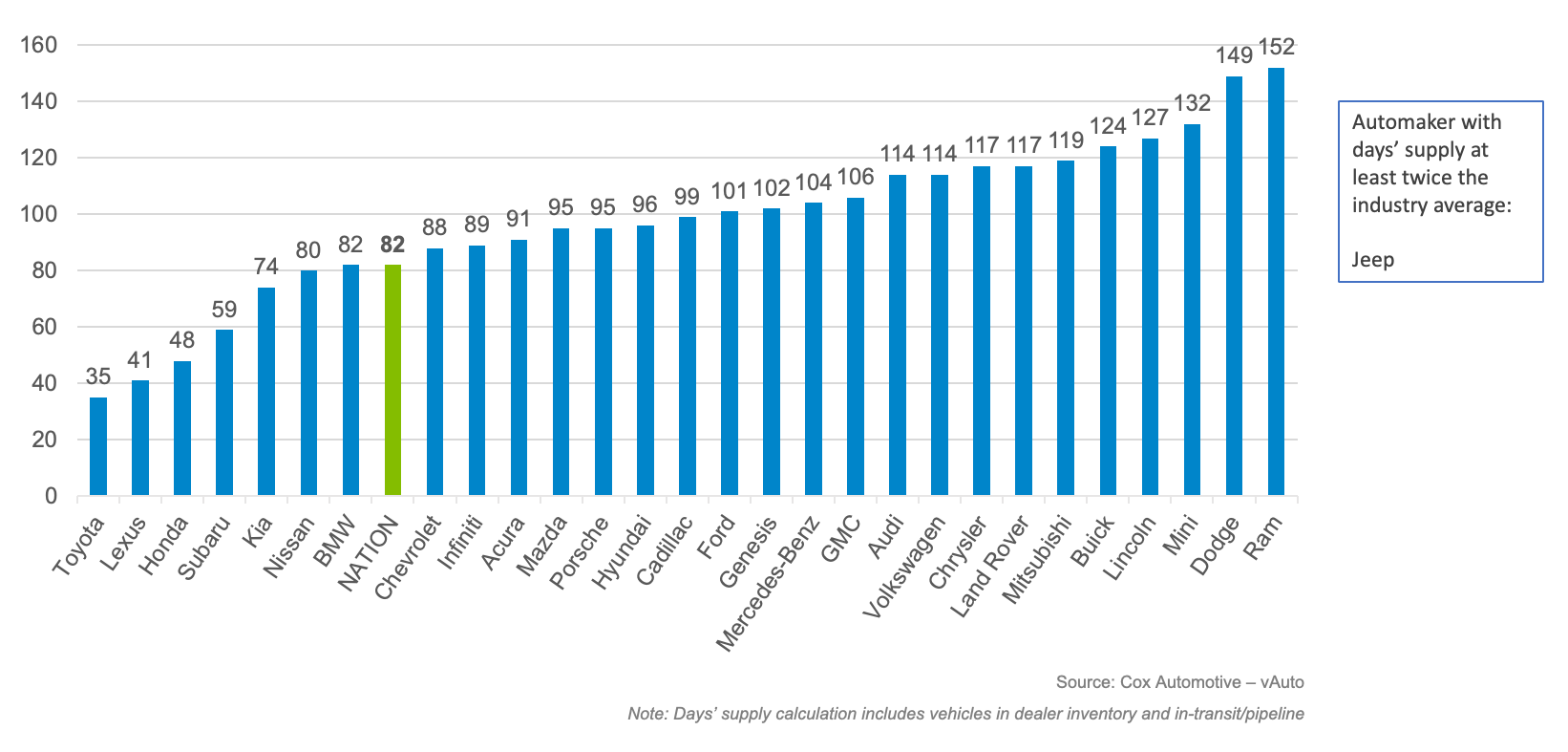
Inventory levels remained uneven across brands. Among major automakers, Toyota continued to have the industry’s tightest inventory position at 35 days’ supply, followed by Lexus at 41 days and Honda at 48 days. Subaru also remained relatively lean at 59 days’ supply.
At the other end of the market, several Stellantis brands continued to carry substantially more inventory. Jeep had 169 days’ supply, Ram had 152 days and Dodge had 149 days. Buick carried 124 days’ supply, while GMC had 106 days and Ford had 101.
The contrast remains notable among the industry’s highest-volume models. Toyota’s RAV4 carried just 24 days’ supply in September, while the Camry had 22 days and the Grand Highlander had 25 days. By comparison, the Ram 1500 carried 142 days’ supply, the Jeep Grand Cherokee had 179 days, and the Jeep Wrangler had 162 days.
September Days’ Supply of Inventory by Brand
Model-Year 2027 Arrivals Accelerate but Remain Behind Last Year
The transition to model-year 2027 vehicles gained momentum in September. Next-model-year vehicles accounted for 22.4% of available inventory at month-end, up from 12.4% in August.
Despite that increase, the transition continued to trail last year’s pace. At the end of September 2025, next-model-year vehicles represented 38.3% of available inventory. The current share is approximately 16 percentage points lower, suggesting that automakers are moving through the annual model-year changeover more slowly than they did a year ago.
The rollout also remained uneven by brand, which isn’t uncommon. However, there is a lighter new-product cycle overall alongside a broader industry rethink of sourcing and product complexity. Additionally, tariffs are adding friction as automakers localize supply chains, simplify powertrains and options, and adjust production strategies, changes that take time and can slow the model-year transition.
Prices Edge Higher as Affordable Supply Remains Tight
The average new-vehicle listing price increased to $49,726 in September, up 0.7% from August and 1.4% from September 2025. The increase in listing prices was consistent with the September rise in the Kelley Blue Book average transaction price.
Vehicles priced below $40,000 accounted for approximately 31% of available inventory. Supply remained tightest at the lower end of the market, with vehicles priced at $30,000 or less carrying 63 days’ supply, while those priced from $30,000 to $40,000 carried 68 days’ supply.
Days’ supply increased steadily at higher price points. Vehicles priced from $50,000 to $60,000 carried 91 days’ supply, those priced from $60,000 to $80,000 had 99 days, and vehicles priced above $80,000 carried 111 days. As covered previously, in a price-sensitive environment, we continue to see customers adapt rather than leave the market and anticipate that higher-priced vehicles may continue to sit for longer.
The Bottom Line
New-vehicle inventory recovered in September as the sales pace eased from August, giving the industry more supply heading into the fourth quarter. Market conditions remain tighter than they were a year ago; however, inventory is lower, and the daily sales pace is stronger than in September 2025.
The market also remains sharply divided. Toyota, Lexus and Honda continue to operate with lean inventory, while several domestic brands carry substantially more supply. At the same time, affordable vehicles remain considerably more constrained than higher-priced models. The model-year 2027 transition is accelerating, but it continues to lag the pace recorded during last year’s changeover.
View Historical New Vehicle Inventory reports.