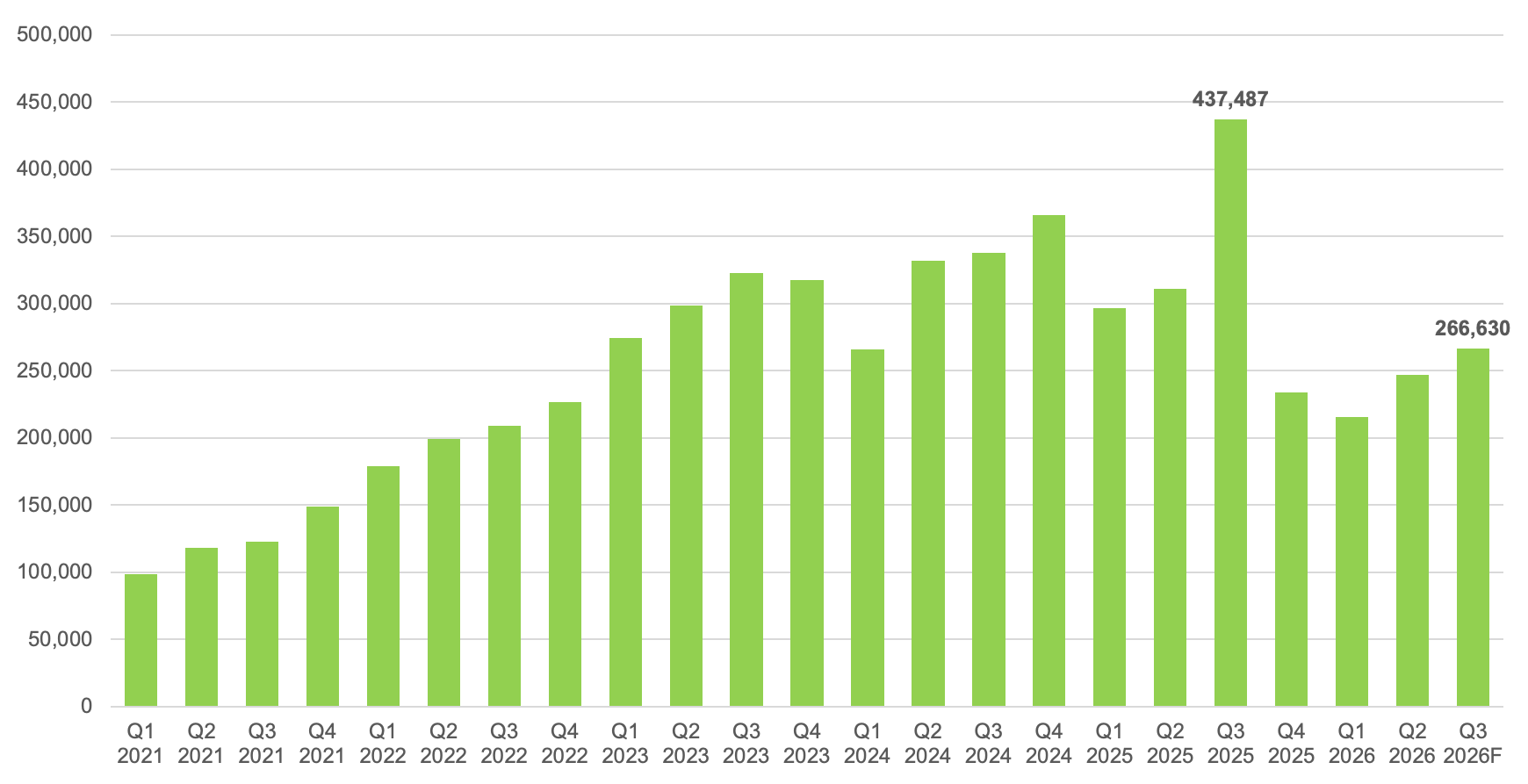
The U.S. electric vehicle market delivered its strongest performance in a year during the third quarter. According to Kelley Blue Book estimates, 266,630 EVs were sold in Q3, up 7.7% from the second quarter and the highest quarterly total since the record-setting third quarter of 2025.
EV sales in Q3 were down 38.6% from a year ago, but that decline was widely expected, as Q3 2025 was the best quarter ever for EV sales in the United States as consumers rushed to take advantage of expiring federal incentives. Beyond the year-over-year decline, the latest results suggest the market continues to recover from a sharp correction.
EV sales in Q3 accounted for approximately 6.5% of all new-vehicle sales, an increase from 5.8% in Q2 and the strongest share since Q3 2025, when EV share moved above 10% for the first time ever. Including traditional hybrid electric vehicles and plug-in models, nearly 25% of all vehicle sales in Q3 were electrified in some manner.
U.S. EV Sales
“What we’re seeing now is a market finding its footing again,” said Stephanie Valdez Streaty, director of Industry Insights at Cox Automotive. “The third quarter was the best result in a year, and improvement through 2026 suggests the reset phase is largely behind us. The next stage of growth will be driven by great products, competitive pricing, and automakers that continue to give consumers compelling reasons to make the switch. And high pump prices are likely helping as well. With gas prices well above $4 a gallon, electric vehicles look better than ever.”
Nearly every automaker posted lower year-over-year EV volume in Q3, although a handful stood out. Toyota and Lexus continued to gain momentum, with EV sales jumping fivefold year over year. Rivian delivered one of the strongest performances in the industry, with sales rising 46% from a year earlier, while Subaru posted 31% growth, supported by an expanding EV lineup. The results demonstrate a singular truth in the auto industry: Consumers respond to compelling new products.
At the same time, the brand with the market’s most mature product line continues to drive industry growth. Despite a 20% year-over-year decline, market leader Tesla remained dominant, accounting for more than half of all EV sales in the United States during the quarter. Tesla sales are now almost entirely driven by two long-running products: the Model Y and the Model 3, with the Model Y accounting for 69% of the company’s sales in Q3 and the Model 3 28%.
The U.S. EV market is smaller than it was, but it appears to be finding a more sustainable footing as automakers shift their strategies, consumers weigh an expanding range of electrified options, and high gas prices offer the segment a healthy and now seemingly sustained tailwind.