Updated, Feb. 4, 2026 – January new‑vehicle sales slowed more than expected as harsh winter weather across large parts of the eastern U.S. in the final week disrupted shopping activity. The seasonally adjusted annual rate (SAAR) of sales is estimated at 14.9 million, below the Cox Automotive forecast of 15.3 million and down from 15.5 million a year ago. The gap is mostly due to weak passenger car sales and reduced SUV imports.
Cox Automotive expected sales to ease somewhat following the stronger-than-anticipated 2025 finish, but the widespread winter weather amplified the slowdown and made the January pullback more pronounced. Even so, underlying demand appears intact, supported by ample inventory, rising credit availability, and relatively healthy sales incentives.
In January, fleet sales finished stronger by an estimated 14% from a year ago, based on a Cox Automotive analysis of preliminary estimates from Bobit. OEMs are likely clearing 2025 model-year vehicles to start the year, and some fleet companies are pulling forward orders ahead of potential tariff-related price increases.
Looking ahead, many weather-delayed purchases are likely to roll into February, which could also see a modest lift from a strengthening tax refund season.
ATLANTA, Jan. 27, 2026 – January new-vehicle sales are expected to start the year at a slower pace than last year and last month. The January seasonally adjusted annual rate of sales (SAAR) is forecasted to finish near 15.3 million, down slightly from last year’s 15.5 million pace and down from December’s upwardly revised 16.1 million level. After a strong third quarter, the automotive market slowed notably – a pace that has carried over into the new year.
New-vehicle sales volume is expected to increase by 3.2% over last year, although the year-over-year gain is largely due to one additional selling day in 2026 and does not reflect a stronger market than one year ago. Compared to December, new-vehicle sales volume is forecast to be lower by 23.5%. A month-over-month decline, however, is typical in January.
“The new-vehicle sales pace always slows in January after the holiday shopping season, and this year is no exception,” said Charlie Chesbrough, senior economist at Cox Automotive. “Sales slowed in the fourth quarter of last year, and that trend is expected to continue into the start of 2026. The loss of EV tax credits at the end of Q3 led to fewer overall sales in Q4, and that will likely continue into the first quarter of 2026. Also, the market is slowing due to ongoing concerns about the U.S. economy and persistently high new-vehicle prices. These market conditions are expected to be major headwinds for the new market throughout 2026.”
January 2026 New-Vehicle Sales Forecast
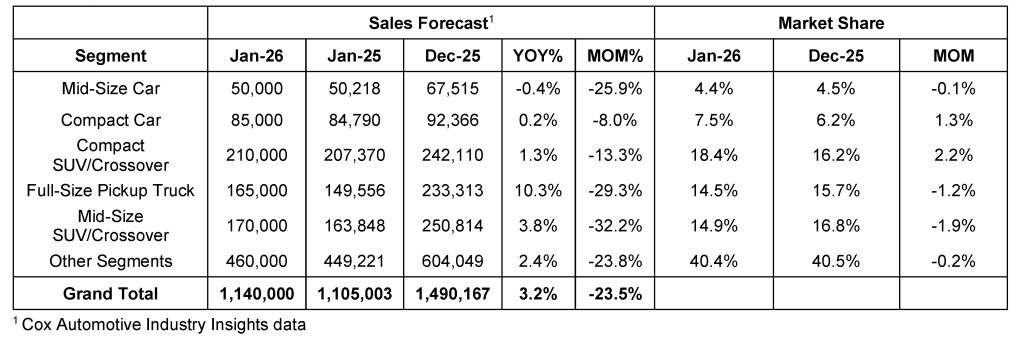
January has 26 selling days, one more than last year and the same as last month.
Tax Refund Season May Provide Boost in Sales
This month’s severe winter weather – Winter Storm Fern – disrupted conditions across much of the nation in the final weekend of January and will likely slow sales as consumers postpone shopping and dealerships face reduced traffic. Even so, some relief may be ahead as tax refunds begin hitting households. With the One Big Beautiful Bill passed in July 2025 expected to generate higher-than-usual refunds, many consumers may see a temporary boost in disposable income.
According to Chesbrough, “Tax season may offer a small but meaningful bump for the auto industry. With larger refunds expected, some consumers who held off earlier in the year may finally have the means – and the confidence – to return to the market.”
Forecast: 2026
After ending 2025 at an estimated 16.3 million units, Cox Automotive forecasts that the new-vehicle sales pace in 2026 will decline to 15.8 million. Slower economic growth, softer job creation, and the loss of EV tax incentives are all expected to weigh on demand. While 2025 outperformed expectations across most metrics, the 2026 outlook points to a more subdued market shaped in part by major forces pulling the economy in different directions, which will simultaneously help and hinder the auto industry in the year ahead.
About Cox Automotive
Cox Automotive is the world’s largest automotive services and technology provider. Fueled by the largest breadth of first- and third-party data fed by 2.3 billion online interactions a year, Cox Automotive tailors leading solutions for car shoppers, auto manufacturers, dealers, lenders and fleets. The company has 29,000+ employees on five continents and a portfolio of industry-leading brands that include Autotrader®, Kelley Blue Book®, Manheim®, vAuto®, Dealertrack®, NextGear Capital™, CentralDispatch® and Cox Fleet®. Cox Automotive is a subsidiary of Cox Enterprises Inc., a privately owned, Atlanta-based company with $23 billion in annual revenue. Cox Automotive has been included on Glassdoor’s Best Companies in Tech & AI 2026 and Best Place to Work in 2026 lists. Visit coxautoinc.com or connect via @CoxAutomotive on X, CoxAutoInc on Facebook or Cox-Automotive-Inc on LinkedIn.
Media Contacts:
Mark Schirmer
734 883 6346
mark.schirmer@coxautoinc.com
Dara Hailes
470 658 0656
dara.hailes@coxautoinc.com