In many ways, artificial intelligence is already changing how Americans shop for vehicles. Consumers are actively using it to research vehicles, compare choices and make sense of one of their largest purchases. Some are even relying on AI for vehicle recommendations.
This new reality was the starting point for a discussion at AutoMobility LA 2026, where Cox Automotive leaders Jessica Stafford, senior vice president of Consumer Solutions, and Jeff Jones, senior vice president of Product and Engineering, Retail Solutions, were on stage to share context of how AI is changing the retail journey for car buyers and what those changes reveal about the future of car buying – a future promising to be more efficient and satisfactory for everyone.
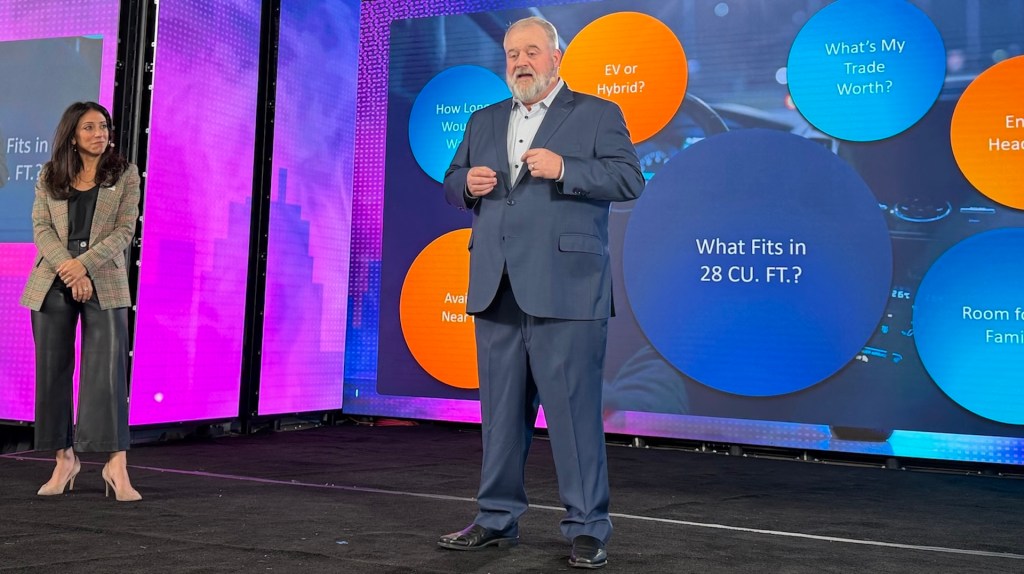
Jones brought the idea to life with his own shopping experience. During a recent drive home, Jones — a true automotive junkie who will confirm he is always shopping for another car — used natural-language, conversational AI to discuss options for his next vehicle. The conversation covered EVs versus hybrids, room for his family, his trade-in, nearby inventory, prices, headroom and even what 28 cubic feet of cargo space would look like with luggage.
“In one conversation, I had told AI more about what I actually needed than I ever would have through traditional search,” Jones noted.
For years, consumers have had to fit their vehicle desires into industry-created terms and filters: best family SUV, hybrid near me, lease under $700, drive type, features, etc. Conversational AI changes everything. Conversational AI allows shoppers to describe their situation: Who the vehicle is for, how it will be used, what they can spend and what matters most.
Many consumers have already embraced this approach. According to the Cox Automotive AI in Auto Retail Tracker, about one in three in-market vehicle shoppers have used AI to research vehicles. Importantly, AI doesn’t necessarily replace familiar parts of the journey. After his conversation, Jones noted he still looked at vehicles online, browsed inventory, and visited dealerships. But those steps were less random, as he had more context, a tighter consideration set, and a clearer understanding of what he wanted.
From accurate to useful
In automotive retail, the use of artificial intelligence puts greater importance on available information that drives the answers. But Stafford and Jones also drew an important distinction between information that is accurate and information that actually helps someone make a decision.
Specifications, reviews, listings, prices, incentives and inventory all help determine what an AI platform can tell a shopper. Long-established automotive resources such as Cox Automotive’s Kelley Blue Book and Autotrader have built authority by providing specific, current information that answers consumers’ questions. That foundation becomes even more significant as AI draws upon information to build answers. Accuracy is more important than ever.
At the same time, Stafford noted, when it comes to valuable vehicle shopping, context is perhaps even more critical. For example: 28 cubic feet of cargo space. The specification may be 100% accurate, but the number alone doesn’t answer the question. As Stafford says, consumers want their problems solved: Is there enough room for a 14-year-old’s catcher’s equipment bag?
“Good information tells me what the vehicle has. Good context tells me what that means for my life,” Stafford added.
Natural-language interaction allows consumers to describe what they are actually trying to accomplish rather than simply identify a vehicle attribute. AI can then connect accurate vehicle information with the context behind the question.
A journey that remembers the shopper
AI is also challenging another familiar part of vehicle shopping: Consumers often have to start over as they move through the journey, and that is a major frustration for everyone.
The average vehicle buyer visits more than four sites, and most consumers say their ideal experience includes online and in-person interactions. A shopper may move from AI research to an automotive marketplace, an OEM website, dealership inventory and a showroom. The context gathered along the way doesn’t always follow, and that is a problem that needs fixing.
AI creates the potential for those experiences to become more connected, remembering what a consumer compared, what matters to them and where they are in the process.
There are limits. Nearly two in three consumers are concerned about sharing personal information, and nearly three in four consumers are not ready to let an AI agent act on their behalf. As Stafford noted: “Trust isn’t only about whether the answer is right. It’s whether I trust you to use what I told you the right way.”
From consumer signals to better decisions
Across millions of shoppers, AI vehicle searches, comparisons and behaviors also become signals about changing demand.
Connecting those signals with inventory and marketplace data can help show where consumer interest is building or softening. That becomes especially important in a dynamic market where gas prices, borrowing costs, incentives, and product strategies can quickly influence consumer behavior. Annual plans still matter, Jones told the audience at AutoMobility LA, but real-time signals can indicate when assumptions behind those plans have changed: “The plan sets the direction. The signals tell you when the assumptions behind it have changed.”
That may be one of AI’s most important implications for automotive. The opportunity isn’t simply having more data or trying to predict every market disruption. It is recognizing change as it happens, understanding the context behind it and responding sooner.
As Stafford put it, “The goal isn’t perfect prediction. It’s better sensing and faster decision-making in the retail world.” That’s how signals become strategy.
Download the presentation: From Signals to Strategy: How AI Is Reshaping the Automotive Customer Journey