Consumer demand for new vehicles remained strong in August, with sales accelerating from July and continuing to draw down available inventory. According to Cox Automotive’s analysis of vAuto Live Market View data, inventory declined for the third consecutive month while the sales pace increased, pushing industry days’ supply to its lowest level since spring 2025.
The market conditions align with findings from the Q3 Cox Automotive Dealer Sentiment Index, where franchised dealers reported lower inventory levels and less pressure to reduce prices. While overall supply remains sufficient to meet demand, inventory is becoming increasingly constrained in the most affordable segments of the market.
2.68M
Available Units
73
Days’ Supply
$49,486
Average Listing Price
Healthy Demand Continues to Reduce Available Supply
The new-vehicle sales pace accelerated in August, rising 3.3% from July and modestly from a year earlier. As demand remained strong, available inventory declined to 2.68 million units from 2.73 million in July, down 1.6% month over month and 1.8% year over year.
As a result, days’ supply fell to 73 days in August, down from the upwardly-revised 77 days in July and below the 75-day level recorded a year earlier. Days’ supply in August was at its lowest level since April 2025.
Inventory Strategies Continue to Vary by Brand
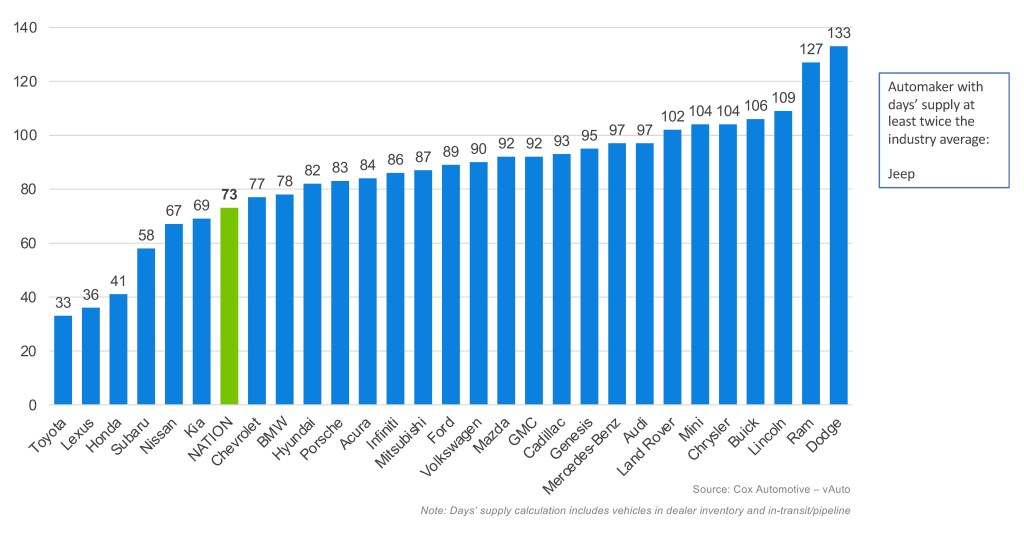
Inventory levels continue to vary significantly by brand. Among major manufacturers, Toyota had the industry’s tightest inventory position at 33 days’ supply at the end of August, followed by Lexus at 36 days and Honda at 41 days. Nissan, notably, continues to show strong inventory discipline, with days’ supply at 67 days, down from 72 days in July and near 100 in Q3 of 2025. At the other end of the spectrum, the Stellantis brands, along with Buick and Lincoln, continued to carry some of the highest inventory levels in the industry.
August Days’ Supply of Inventory by Brand
Model-Year 2027 Arrivals Increase but Remain Behind Last Year’s Pace
The rollout of model-year 2027 vehicles accelerated in August, with next-model-year vehicles represented 12.4% of available inventory at month-end, more than double the 5.6% share recorded in July. Even with that increase, the transition remains well behind last year’s pace. At the end of August 2025, model-year 2026 vehicles accounted for 23% of available inventory, nearly twice the current share.
The arrival of model-year 2027 vehicles is uneven across the industry. Kia, Cadillac, BMW and Lincoln have already seen growing availability, while Toyota, VW and Subaru remain much earlier in the rollout. The contrast is especially notable at Toyota and Lexus, where inventory remains among the tightest in the industry and next-model-year vehicles remain limited.
Prices Remain Stable, but Affordability Pressures Persist
The average new-vehicle listing price increased to $49,486 in August, up 0.6% from July and 1.9% from August 2025. The increase aligns with August Kelley Blue Book transaction price data.
Vehicles priced below $40,000 accounted for roughly one-third of available inventory in August. Supply remained tightest at the lower end of the market. Vehicles priced at $30,000 or less carried 54 days of supply, while vehicles priced above $60,000 had more than 90 days of supply.
Overall, supply remains adequate, but most affordable models continue to be the market’s most constrained segment.
The Bottom Line
Despite persistent economic pressures on many households, new-vehicle demand remains healthy. Pricing is comparatively stable, but inventory remains tightest in the market’s most affordable segments.
The transition to model-year 2027 vehicles is gaining momentum but remains considerably slower than last year’s rollout. Because automakers often adjust pricing during model-year transitions, the slower rollout of next-model-year vehicles may be helping keep listing prices relatively stable.
View Historical New Vehicle Inventory reports.