
September showed a more resilient electric vehicle (EV) market than headline sales volumes suggest. New EV sales edged lower, but EV share increased as the broader new-vehicle market contracted, while used EV sales rose to a record share of used-vehicle sales. Inventory tightened considerably, with both new and used EV days’ supply falling below ICE+ levels, while used EV pricing moved closer to ICE+ vehicles.
New and Used EV Sales – September
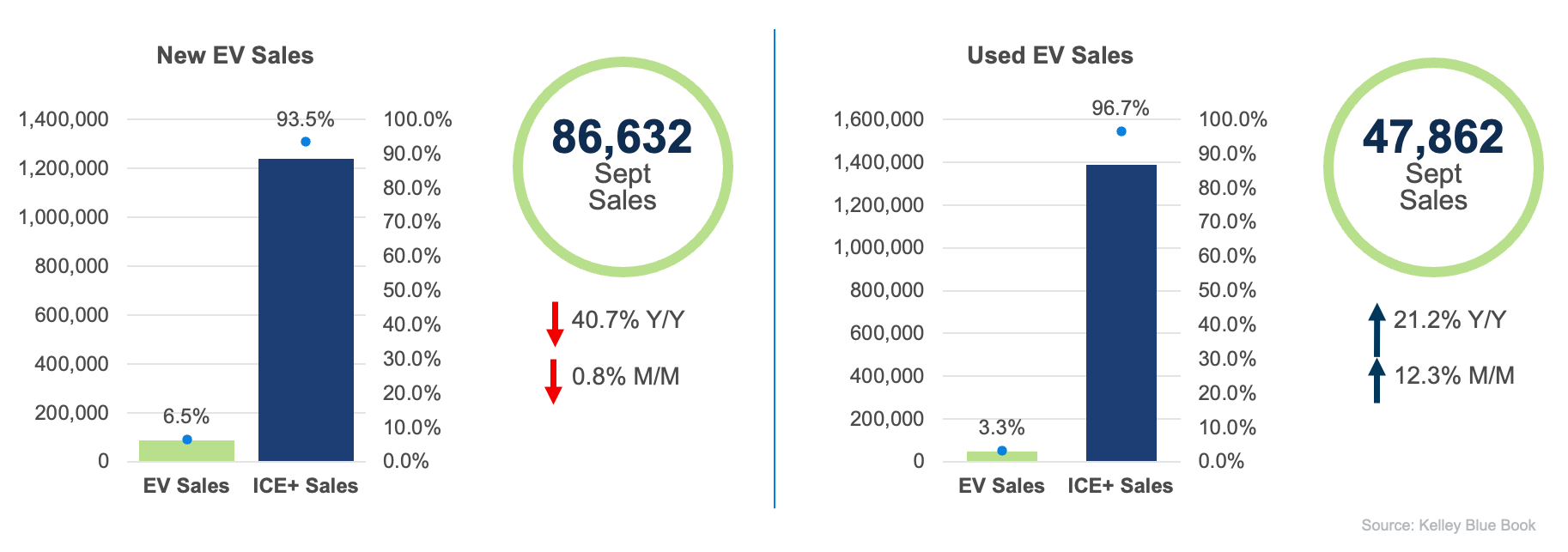
New EV Sales: New EV sales totaled an estimated 86,632 units in September, down 0.8% from August and 40.7% from a year earlier. Despite the slight month-over-month decline in volume, EV share increased to 6.5% of total new-vehicle sales, up from 6.3% in August, as ICE+ sales declined 5%. The sizeable year-over-year decline reflects the elevated comparison with September 2025, when EV sales reached 146,076 units and accounted for 11.5% of new-vehicle sales.
Tesla remained the dominant player with 48,367 units sold, up 1.7% month over month, followed by Rivian with 6,737 (+6.1%), Cadillac with 4,655 (+21.5%), Toyota with 3,909 (-20.9%) and Kia with 3,654 (+21.8%). Tesla’s share of EV sales increased to 55.8%, up approximately 1.4 percentage points from August. Among the other leading makes, Cadillac and Kia posted particularly strong gains, with Cadillac benefiting from higher OPTIQ and LYRIQ sales, while Kia gained from the EV9 and EV6 and the addition of the EV3.
Used EV Sales: Used EV sales increased 12.3% month over month and 21.2% year over year in September to an estimated 47,862 units. Used EV share rose to a record 3.3% of total used-vehicle sales, up from 2.9% in August, as ICE+ sales declined 4.4%. The expanding flow of used EVs, including off-lease vehicles, continues to support sales and availability.
Tesla remained the leading used EV brand, with sales increasing 3.3% month over month, followed by Ford (+17.1%), Chevrolet (+21.3%), Hyundai (+5.3%) and BMW (+3.9%). Nissan (+37.8%), GMC (+22.7%), Kia (+20.6%) and Audi (+17.6%) recorded stronger gains. At the model level, growth was led by the Nissan Ariya (+42.5%), Chevrolet Equinox EV (+41.9%), Kia EV9 (+36.2%) and Chevrolet Blazer EV (+30.2%), with the Ford Mustang Mach-E (+14.7%) and Tesla Model Y (+13.8%) also increasing.
New and Used EV Days’ Supply – September
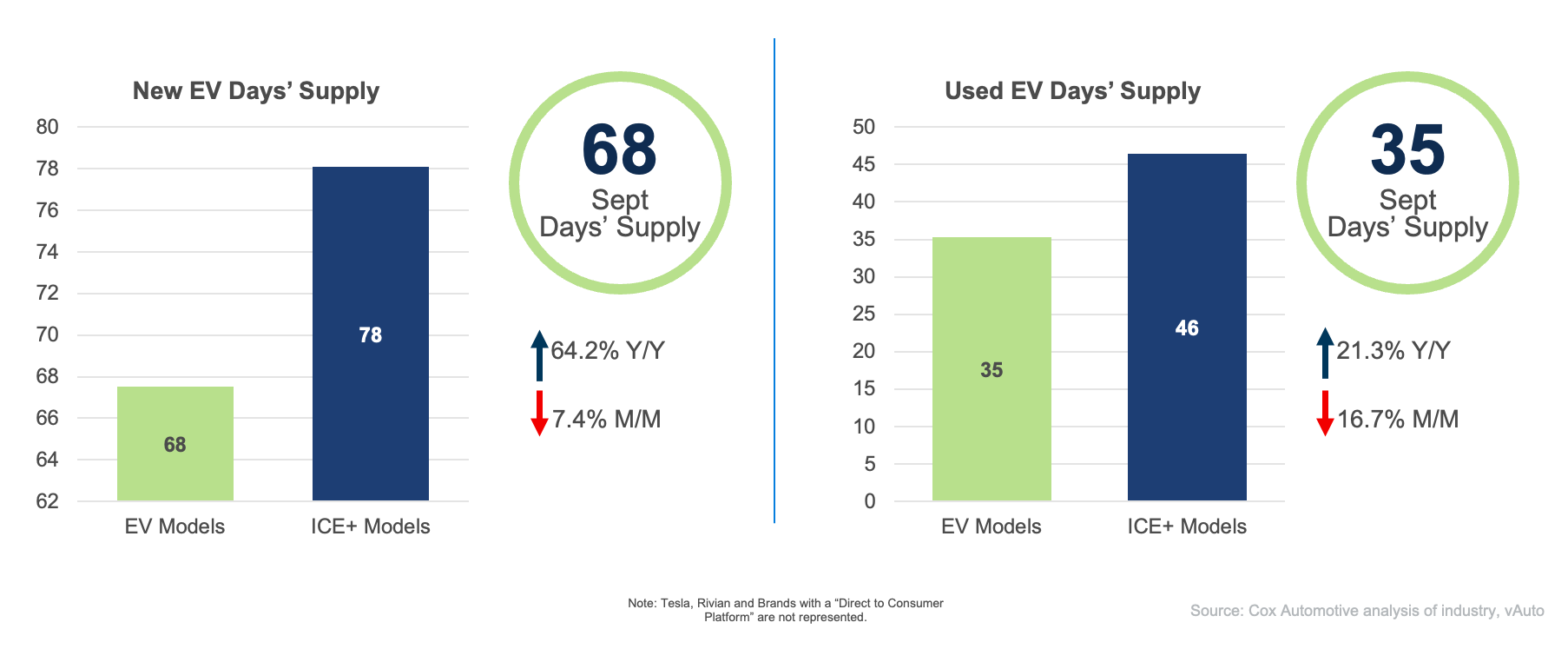
New EV Days’ Supply: New EV days’ supply decreased to 68 days, down 7.4% month over month, but remained 64.2% higher year over year. By comparison, ICE+ supply increased 4.8% month over month to 78 days and was 12.4% lower than a year ago. New EV supply now sits 10 days below ICE+ supply, the largest EV-to-ICE+ supply gap of 2026.
Inventory levels remain uneven across brands. Subaru is still the leanest at just 15 days, while Cadillac, Honda, Nissan, Volkswagen and GMC saw significant declines in September. Several brands saw days’ supply rise in October, led by Tesla, Mercedes-Benz, Ford and Audi.
Used EV Days’ Supply: Used EV days’ supply decreased to 35 days, down 16.7% month over month, but remained 21.3% higher year over year. By comparison, ICE+ supply increased 2% month over month to 46 days and was 6.3% lower than a year ago. Used EV supply now sits 11 days below ICE+ supply, the largest EV-to-ICE+ supply gap of 2026.
Availability tightened broadly across brands. Tesla remained the leanest among major brands at 27 days, followed by Hyundai at 30 days and Ford at 33 days. Kia, Nissan and GMC also saw notable declines, while Mercedes-Benz remained among the higher-supply major brands at 60 days.
Note: Tesla and Rivian figures reflect only vehicles available through traditional dealerships and exclude vehicles at factory-owned outlets.
New and Used EV Prices – September
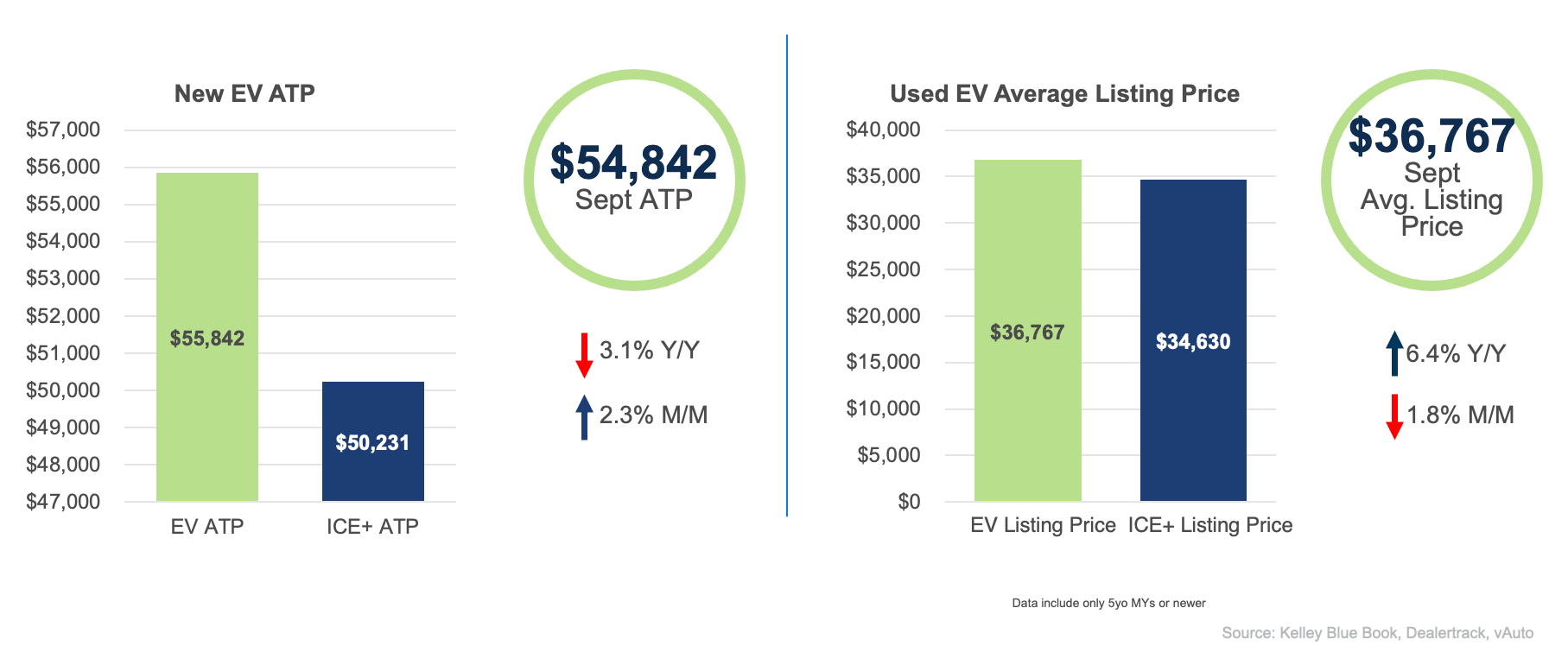
New EV ATP: The average transaction price (ATP) for a new EV increased to $55,842 in September, up 2.3% from August but down 3.1% from a year ago. The EV price premium over ICE+ vehicles increased to $5,611, from $4,833 in August, but remained well below the 2025 average premium of $8,665. EV incentives declined to 11% of ATP, the lowest level of 2026, averaging approximately $6,117 per vehicle, down from $6,509 in August and 14.2% of ATP a year ago.
The increase in EV ATP was driven largely by higher prices for Tesla’s two highest-volume models and a richer sales mix. Model 3 ATP rose 8.6% to $53,804, while Model Y ATP increased 1.3% to $53,052 as sales also increased. Stronger sales of higher-priced models, including the BMW iX3, Cadillac LYRIQ, Kia EV9 and Lucid Gravity, provided additional lift to the overall EV ATP.
For more details, read the September Kelley Blue Book ATP report.
Used EV Listing Price: Used EV prices continued to ease in September, even as sales reached a record share of the used-vehicle market. The average listing price for a used EV declined to $36,767, down 1.8% from August but up 6.4% from a year ago. The premium over ICE+ vehicles narrowed to $2,137, or 6.2%, from $2,692 in August, improving affordability relative to ICE+ vehicles.
Despite a 1.4% increase in Tesla’s average listing price to $33,470, the overall average listing price declined amid lower prices across several high-volume non-Tesla models, including the Nissan Ariya (-5.9%), Cadillac LYRIQ (-3.9%), BMW iX (-3.8%) and Chevrolet Blazer EV (-3%).
Looking Ahead
The EV market continues to adjust following last year’s federal tax credit expiration, with new and used EV markets showing increasingly different dynamics. New EV sales remain well below last year’s elevated levels, but September’s higher share and tighter inventory point to continued market rebalancing. Meanwhile, used EV sales continue to grow as pricing moves closer to ICE+ vehicles and more off-lease EVs enter the market. Sales, inventory, pricing and incentives will remain key indicators to watch.
The EV Market Monitor gauges the health of the new and used electric vehicle (EV) markets by monitoring sales volume, days’ supply and average pricing. Each metric will be measured month over month and year over year.
Follow the link to view the entire series of EV Market Monitor reports.
For the official quarterly report on EV sales data, see the Q3 Electric Vehicle Sales Report.