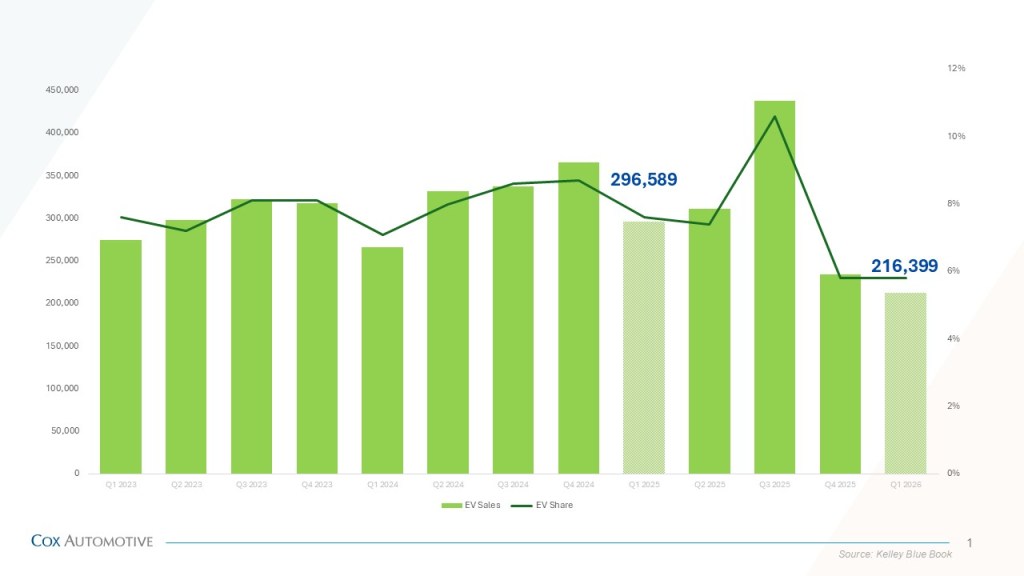
Electric-vehicles sales fell by 27% year over year in Q1, according to the latest counts from Cox Automotive’s Kelley Blue Book. At 216,399, EV sales in Q1 were lower by 7.8% compared to the previous quarter, an improvement and suggesting the sales drop after government-back incentives were terminated has slowed. In Q4 2025, sales were lower by 36% year over year and 46% quarter over quarter.
EVs accounted for 5.8% of total new-vehicle sales in Q1, unchanged from Q4 2025 and well below the peak of 10.6% in Q3 2025.
New U.S. Electric Vehicle Sales and Share
The EV market in the U.S. has clearly entered a new chapter, one being written without government support. Most automakers have already significantly reshuffled EV plans, and many have notably throttled back production. The year-over-year sales declines by most major automakers is significant – many saw sales down 60%-to-70% or more in Q1. The declines have been expected by Cox Automotive analysts for a year now.
“The U.S. EV market has clearly entered a new phase,” said Stephanie Valdez Streaty, director of insights at Cox Automotive. “With federal incentives gone, the first quarter reflected a necessary reset – sales slowed and market share shifted. What comes next will be driven less by policy and more by fundamentals: more affordable products, smarter pricing strategies, and continued investment in infrastructure. Those longer-term fundamentals continue to support EV growth. The timeline has shifted, but the direction hasn’t.”
A few brands stood out in Q1 by delivering year-over-year growth, notable Cadillac, Lexus, and Toyota. The growth was from a small base, so not entirely surprising, but noteworthy and particularly for Toyota, the industry’s electrified leader. Rivian and Lucid also delivered year-over-year growth in Q1; Lucid’s gain was thanks to a strong new product. Market leader Tesla is mostly focused only on two vehicles now, Model 3 and Model Y, and while overall sales were lower versus 2025, the Model Y saw strongly higher sales in Q1 and Tesla brand won back significant market share. One out of every three EVs sold in Q1 was a Tesla Model Y.
With the recent volatility in fuel prices driven by a war in the Middle East, interest in EVs has increased and shopping traffic at Cox Automotive’s Kelley Blue Book and Autotrader sights has notably improved. Still, shopping traffic is only one measure. Sales are the measure that counts, and history shows that a meaningful shift in the automotive industry is a slow process. Hybrids are now mainstream in America. It’s been a 25-year journey.
“It’s not uncommon for us to see a spike in EV-related searches when gas prices rise. Searching is free,” explains Kelley Blue Book Managing Editor Sean Tucker. “A spike in actual sales would be unprecedented after just a month of high gas prices, because shopping for a new car is a long process influenced by many factors.”
The next chapter in the EV market will be shaped less by policy and more by new product and pricing strategies. New EV prices have been trending lower and incentives remain plentiful, helping to offset affordability concerns for many shoppers, and there are smaller, more affordable EV options on the way. At the same time, a growing volume of off lease EVs and used EV inventory is entering the market, expanding choice but also providing new competition in the market. EV share of new-vehicle sales will likely increase from here, but the march back to 10% is going to be slow.