
Last week, I had the opportunity to walk through Scout Motors’ new Production Center in Blythewood, South Carolina. I went in familiar with the Scout story. I came out with a much better appreciation for both how quickly this company has come together and how much still has to go right.
First, a disclosure is important here. From 2007 to 2012, I worked as an agency partner to Audi of America, then joined Audi in-house through 2017. During those years, I worked closely with Audi AG and directly with Scott Keogh, now president and CEO of Scout Motors.
I knew Keogh first as a marketer, and that matters to this story. He understands that a great vehicle alone doesn’t create a great automotive brand. Scout is clearly being built to be both. But branding only gets you so far. That’s why one word Keogh kept returning to during our visit stood out: validation.
That may be the best way to understand where Scout is today. Four years ago, Scout was little more than an idea. Ground wasn’t broken in South Carolina until February 2024. Today, Scout has more than 1,800 employees, a massive manufacturing complex, a growing supplier base and validation vehicles moving through production. Customer deliveries are expected to begin in 2028.
That’s fast by industry standards, though it depends on where you start the clock. Rivian took roughly 12 years from its founding to its first R1T deliveries, or about four years and eight months from acquiring its Illinois factory. Lucid took about seven years from its shift toward vehicle development to its first Air deliveries, although its Arizona factory went from construction to deliveries in less than two years. BMW, an established manufacturer, announced its South Carolina plant in 1992 and built its first vehicle about 27 months later.
Scout sits somewhere between those examples: an independent American company starting largely from a blank sheet, but with Volkswagen Group AG as its sole investor. To be clear, Scout Motors isn’t a Volkswagen Group of America operation. It is an independent U.S. company incorporated in Delaware and backed by one of the world’s largest automakers. That relationship has also become part of the debate surrounding Scout’s direct-to-consumer strategy, including ongoing litigation with Volkswagen dealers. For now, this is where validation comes in.
Getting an ambitious idea approved inside a global automaker is one thing. Continuing to earn investment as it moves toward execution is another. Scout is investing more than $2 billion in the Production Center and another $300 million in its on-site Supplier Park.
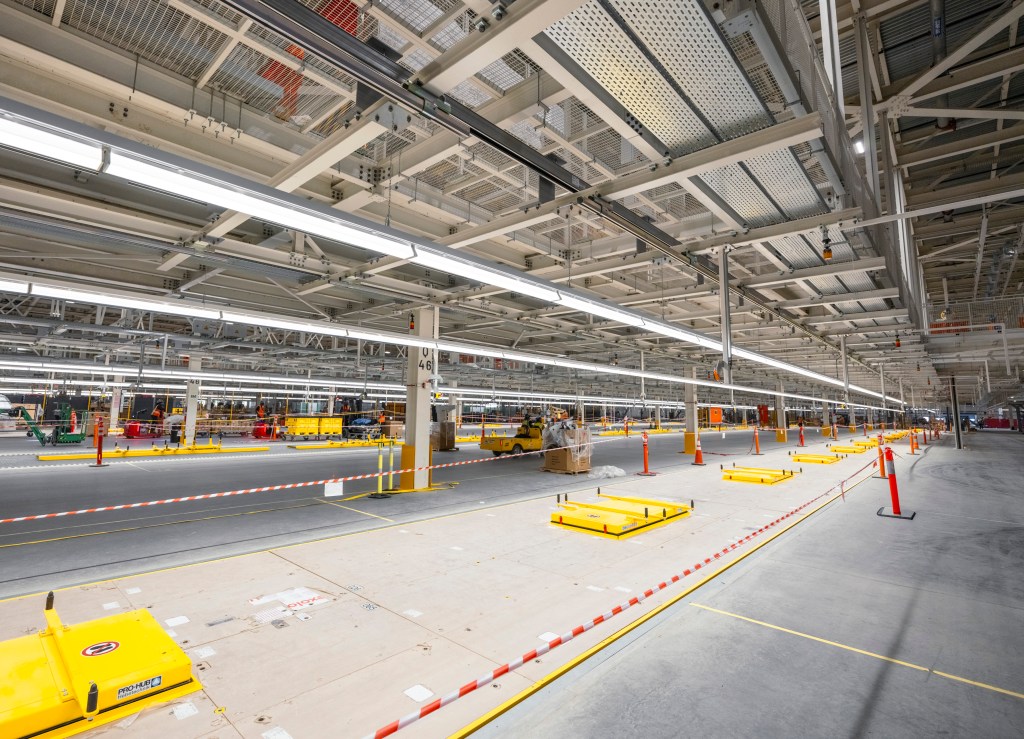
But Keogh pointed to another number that I found even more interesting: $368 million in investment committed by suppliers themselves. These companies are betting on vehicles that aren’t in production yet. Sodecia Aapico, a joint venture between Portuguese and Thai Tier 1 suppliers, is investing $120 million in a South Carolina ladder-frame plant, and Brose Sitech, a seating supplier jointly owned by Brose and Volkswagen, is investing $29.5 million in its first U.S. manufacturing operation, inside Scout’s Supplier Park.
That’s external validation. Volkswagen Group AG’s investment tells you its investor believes in the business case. Supplier investment tells you other companies are willing to put their own balance sheets behind it. Having a global automaker standing behind Scout no doubt makes that commitment easier, and it’s an advantage startups without that kind of backing haven’t always had. Now you can physically see where that money is going.
The 1,600-acre Blythewood site includes the 3 million-square-foot Scout Production Center and more than 2 million square feet for the Supplier Park, with a planned capacity of up to 200,000 vehicles a year. Walking through body, paint and assembly makes the progress tangible, but it’s important to tell progress apart from completion. These are validation vehicles. Scout is still proving out the equipment, processes, components and vehicles. Next, Scout has to validate manufacturing at scale, the product, its retail and service model, and, ultimately, lasting consumer demand.
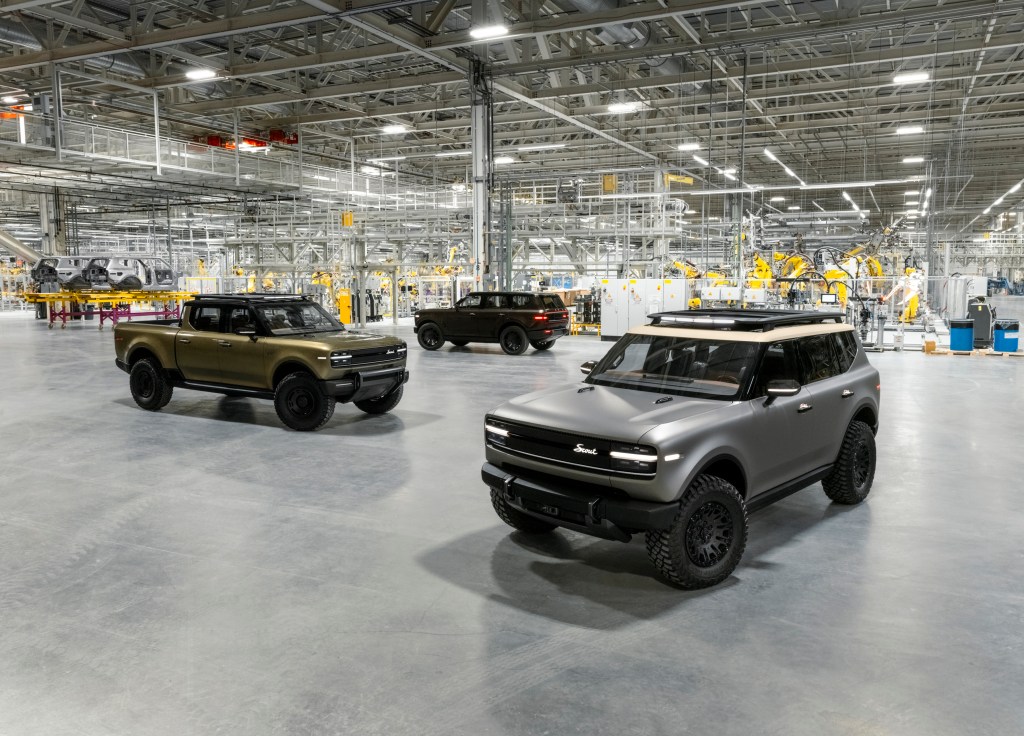
The Traveler SUV and Terra truck will use a body-on-frame architecture developed for the U.S. market. Both will come with an all-electric powertrain targeting roughly 350 miles of range and a Harvester range-extender version targeting more than 500 miles of combined range. In today’s tariff environment, having a vehicle conceived, engineered and built for the U.S. market carries strategic value that probably wasn’t fully appreciated four years ago.
Scout is also bringing just-in-time logistics, battery assembly and accessory installation closer to the production line. That could reduce some of the inventory, logistics costs and capital tied up between the factory and the customer.
That brings me to the part of Scout’s strategy where my enthusiasm comes with a very real asterisk: direct-to-consumer sales. Scout talks about selling direct less as cutting out the dealer and more as cutting out inefficiency, meaning the inventory and handoffs that sit between the factory and the buyer.
At Cox Automotive, we support dealers every day, and I appreciate what they contribute to the transaction and well beyond it. They help consumers through a purchase that state laws, regulations, financing and paperwork make genuinely complicated. They also invest enormous capital in their businesses and communities, handle complex service and repair needs, manage trade-ins and used vehicles, arrange financing and absorb inventory risk. None of that goes away because a purchase moves online.
Scout’s approach has understandably created tension with Volkswagen Group’s U.S. dealers, tension that’s now playing out in court. From the dealers’ perspective, a company backed by Volkswagen Group AG is entering the market with a model that challenges the franchise system in which they’ve invested heavily in. And it’s doing so with vehicles in a segment those dealers have been asking for over the years.
Admiring what Scout has built doesn’t require dismissing those concerns. And a factory, however impressive, doesn’t prove a retail model. That’s another validation point ahead.
Scout expects the Production Center to support more than 4,000 permanent jobs, plus roughly 1,000 on-site supplier jobs and an additional 4,500 supplier jobs off-site. To prepare that workforce, Scout and readySC have also opened a $25 million on-site Training Center. I was especially interested in AI-enabled devices that provide individualized training and faster feedback. This is AI with a practical purpose: helping people learn complicated work faster.
Then there’s the brand. More than 210,000 people have made reservations for a Scout. That’s demand validation and remarkable brand-building for a company that hasn’t delivered a vehicle yet. This is where knowing Keogh gives me a slightly different perspective. I watched him help build tremendous cachet for Audi in the U.S., and I’ve always considered his marketing instincts one of his greatest strengths. You can see the same understanding at work with Scout: People don’t simply buy specifications. They buy into what a vehicle, and the brand behind it, represents.
But 210,000 reservations aren’t 210,000 sales. Reservations have to become orders. Orders have to become deliveries. Deliveries have to become satisfied owners. Keogh himself described 80,000 to 100,000 units a year as something approaching “clear skies,” and said real success means 12 to 18 months of sustained sales. I appreciated that realism.
Four years ago, Scout needed people to believe in an idea. Today it has a factory, a workforce, an investor still writing checks, suppliers betting alongside it, a brand with more than 210,000 reservations, and vehicles moving through production.
There are still reasons for caution. Scaling a plant, launching vehicles and building a new retail and service model are all hard. Turning enthusiasm into loyal, profitable customers may be the hardest validation of all.
Scout has already passed more validation points than many expected. The hard part is what comes next. After seeing Blythewood firsthand, I wouldn’t underestimate their chances.