Every time a vehicle enters or leaves a dealership, someone is placing trust in a process, a company and, ultimately, another person. Vehicle transportation has never been faster or more connected. But as the industry has gone digital, the people looking to exploit vulnerabilities have evolved right alongside it.
At Ohio IADA 2026, Central Dispatch’s Caleb Oakley, senior manager of Marketplace Integrity, walked dealers through today’s automotive logistics risk landscape and what it will take to secure it. His message: Digital logistics isn’t the problem. Falling behind on security is.
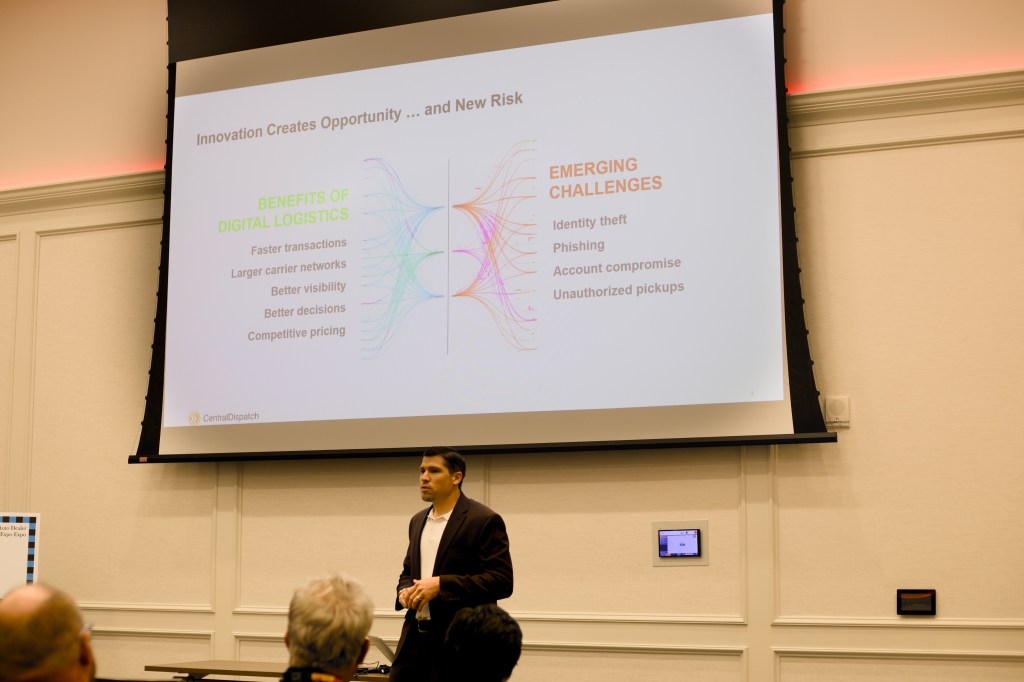
“The conversation isn’t whether digital logistics is the future. It absolutely is,” Oakley said. “The question is whether security is evolving at the same pace.”
Not a Vehicle Problem. A Trust Problem.
Oakley was quick to put the issue in perspective. The vast majority of vehicle moves happen successfully every day. The challenge isn’t widespread breakdowns; it’s that bad actors are becoming more sophisticated.
The same innovations that give dealers larger carrier networks, better visibility, competitive pricing and faster transactions also create new openings for fraud. The most common tactics include fraudsters posing as legitimate carriers, phishing, identity theft, double brokering and unauthorized pickups.
“Most of these aren’t vehicle problems,” Oakley said. “They’re trust problems.”
Many schemes start with something that looks completely routine: an email, a phone call, a credential or a pickup request. And fraudsters rarely need highly technical vulnerabilities. They look for inconsistencies, the places where assumptions replace verification and the gaps between one process and the next.
The Moment of Highest Vulnerability
In transportation, Oakley said, everything eventually comes down to one question: who gets the keys?
The change of custody is where physical assets and digital information meet. The load assignment may be right, the carrier may be legitimate and the dispatch information may be accurate. But if the wrong person takes possession of the vehicle, none of that matters.
It’s also where unwilling participants are often drawn into a fraud scheme. Someone may believe they’re following the correct process, working with a legitimate party or releasing a vehicle to the right person, only to discover later that fraud entered the transaction. A single failure at the point of transfer can create significant operational and financial consequences.
Security Is a Team Sport
If there’s one lesson the industry has learned over the last several years, Oakley said, it’s that no organization can solve fraud alone. Dealers, carriers, shippers, pickup locations, technology platforms and industry partners all have a role to play.
“Fraud thrives when people assume somebody else is handling it,” he said. “Fraud prevention succeeds when everyone participates.”
The encouraging news is that the industry is embracing that mindset. Education, verification standards and accountability have all improved, and small process changes are often creating meaningful reductions in risk.
Building Trust in Layers
Once security is treated as a shared responsibility, the next question is how to build protection directly into the transportation process. Oakley’s answer: layers. He outlined the building blocks Central Dispatch has put in place:
- Identity verification. Central Dispatch implemented biometric identity verification across its marketplace earlier this year, which requires every user to pass verification before gaining platform access.
- Carrier verification. Where identity verification confirms who an individual is, carrier verification answers who the business is, giving customers access to credentials, insurance details, operating history and Federal Motor Carrier Safety Administration-related information before a load is assigned.
- Carrier scorecards. Authority, performance history, ratings, company information and potential warning indicators are available directly within the workflow.
- Account security. User permissions, multi-factor authentication and user management tools help reduce credential sharing and ensure people only access what they should.
- Marketplace integrity and fraud monitoring. Dedicated fraud, monitoring and compliance teams investigate suspicious activity, supported by machine learning and real-time alerts.
- Phishing defense. Central Dispatch and Cox Automotive security teams monitor for phishing sites targeting transportation participants and remove them if any are discovered.
“None of these layers work alone,” Oakley said. “The strength comes from all of them working together.”
The Next Frontier: Verifying the Handoff
For years, the industry focused on verifying companies. Then it focused on verifying users. According to Oakley, the next step is verifying the handoff itself, because despite all the technology in transportation today, vehicle release often still depends on paperwork, phone calls and verbal confirmation. Fraudsters understand those weak points.
Oakley pointed to Secure Vehicle Transfer, which Central Dispatch launched in August 2026, as one way to close that gap. At pickup, the driver presents a digital credential tied to that specific VIN, carrier and location. If the assignment changes, the credential can be revoked on the spot. That turns what used to be a verbal confirmation or a signature on paper into a recorded event, and it typically takes about 90 seconds.
“Security should not have to come at the expense of efficiency,” Oakley said. “The goal isn’t adding friction. The goal is adding confidence.”
From Assumed Custody to Verified Custody
Oakley called this the most important idea of the session. Transportation is really a series of custody transfers: from vehicle owner, to auction or dealer, to carrier, to driver, to destination. Every handoff creates an opportunity for either trust or uncertainty.
Historically, the industry has relied on assumed custody, built on paper processes, verbal confirmation and manual checks. For years, that was often enough. Going forward, Oakley argued, the standard needs to be custody that is verified, documented and auditable.
“That’s what creates trust,” he said. “Not assumptions. Verification.”
Three Takeaways for Dealers
- Treat release as a checkpoint. The change of custody is the moment of highest risk. Verify who is picking up a vehicle rather than relying on paperwork or a phone call alone.
- Close the gaps between processes. Fraud tends to succeed where assumptions replace verification. Use identity and carrier verification tools before a vehicle ever moves, and avoid shared credentials.
- Own your part. Security works best when every participant in the transaction plays a role. Small process improvements can meaningfully reduce risk.
The Bottom Line
The future of logistics security is built on identity, accountability and transparency: stronger verification, more connected workflows, better visibility, machine learning-based fraud detection and digital chain-of-custody processes. As Oakley put it, the strongest marketplaces aren’t necessarily the fastest. They’re the ones participants trust.
“Every major advancement in our industry started as a new habit,” Oakley said. “Digital marketplaces were once new. Electronic dispatching was once new. Real-time tracking was once new. Secure vehicle transfer and verified custody may feel new today, but I believe they’ll become the standard we eventually wonder how we ever worked without.”
[DH1]Perhaps flip this around and have the solution be digital credentialing and Secure Vehicle Transfer an example.