
The economic data slowed in the past week, but market activity certainly did not. In this issue of the Auto Market Weekly Summary, we cover the mid-month update on Manheim valuation trends, as well as updated data points on consumer sentiment and spending. With gas prices holding close to $4.30 per gallon and growing concerns around the AI trade, all eyes are on the Fed meeting this week.
Bottom Line Up Front
The Fed holds its second-to-last meeting of the year this week, with heavy scrutiny on both the decision and the best path for rate policy into year end. Gas prices have held at or above $4.30 per gallon all month, and diesel is roughly 20 cents below its all-time high: a harbinger of the cost to move goods across the economy at a critical time of year.
September inflation readings re-accelerated, with the PPI report showing the largest year over year increase since late 2022. Under normal circumstances, the market likely would have expected higher rates. Instead, concerns about an economy increasingly supported by a single sector – artificial intelligence, and returns on investment there – drove investors into Treasury bonds this past week and helped pull the 10-year yield back down toward 5%.
In this environment, does the committee raise again and risk slowing the economy further, or do they remain forthright in their remit to get inflation down quickly? Either choice carries secondary risks that could offset their goals, and with the midterm elections now just days away, the committee may also see value in pausing to judge the effects of their earlier decisions. As we’ve noted before, the lack of forward guidance from the Fed has added uncertainty and has likely contributed to the rise in loan rates over recent months, which now may be weighing further on the economy.
For the vehicle market, despite declines in consumer sentiment, retail sales are holding up through October. The Cox Automotive new-vehicle sales forecast will be shared on Tuesday, October 27. One theme is holding true: Consumers keep spending, and the oldest car parc on record continues to provide steady marginal demand.
The Cost of Money
One factor impacting the vehicle market is the cost of money becoming a much larger part of the equation, with interest on a typical new-vehicle purchase up 79% since 2019 to $10.1K and up 96% to $10.9K for a used vehicle over the life of the loan. In fact, due to higher financing costs, the average used-vehicle downpayments has dropped to nearly 0% of a typical loan. This has helped push the all-in cost higher by 37% for new and 43% for used versus 2019, outpacing the roughly 30% rise in vehicle price alone.
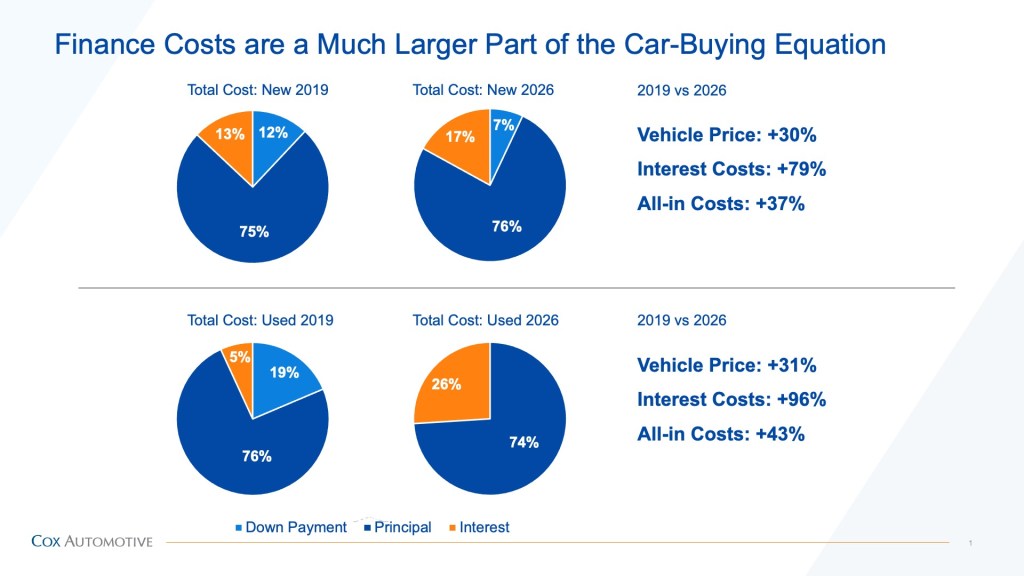
Further increases in rates will likely push consumers to wait it out. With myriad crosscurrents washing across our economy, holding steady and waiting to see may be the Fed’s best policy path for now, and that’s what futures markets are betting the outcome of this week’s meeting will be.
Mid-Month Manheim Valuation Trends
The Manheim Used Vehicle Value Index (MUVVI) rose through the midpoint of October, as is normal from a seasonal point of view. October is often the weakest month of the year for wholesale vehicle values, so seasonal adjustments on average cause the index to rise from prior month. However, non-seasonally adjusted values continued to decline and fell more than we usually observe.
- The MUVVI index increased to 207.4, showing a rise of 0.7% month over month. The index in mid-October was higher by 2.2% year over year.
- Part of the gain was driven by a weaker comparison versus last year, as valuation trends in October 2025 meaningfully corrected from stronger levels driven by tariff impacts on vehicle prices.
- Non-seasonally adjusted Manheim values fell by 2% in the first half of the month, more than usually seen. Values were lower than September across all major segments.
- On an unadjusted basis, EV values in mid-October were higher by 5.3% against 2025 levels, while non-EV values were lower over the same period by 0.2%.
Consumer Sentiment and Consumer Spending
Consumer sentiment readings continue to slowly decline across multiple reporting agencies in October, no matter which part of the market is being observed. To the surprise of many economists, consumer spending patterns remain positive against last year, though the rates of increase have decelerated in recent weeks.
- According to Morning Consult, consumer sentiment readings are lower by 0.8% so far in October against September levels and are currently 8.6% lower against last year.
- Morning Consult’s sentiment readings by income group show lower sentiment year over year across the board. The $100K to $150K cohort is down the most, falling almost 16% while the highest income bracket, at $250K and above, shows the smallest decline against last year, down 2.5%.
- Morning Consult also provides insight into sentiment trends by political party affiliation, and again all groups are now lower on a year over year. Consumers identifying as Democrats are down 1.8% and are the lowest by level. Those who identify as Republican show a higher overall level of sentiment, but they are down the most, lower by 11%. Independents are in between, yet closer to Democrats overall, and down 3.4%.
- The University of Michigan’s report indicates consumer sentiment has also declined this month and is lower by 0.2% month over month and down 10.4% compared to one year ago.
- One-year inflation expectations from the University of Michigan are currently at 4.7%, while the 5-year inflation expectation rose to 3.5%. Both were modestly higher compared to September.
- Consumer spending, measured by Bloomberg, shows growth of almost 2% for the most recent week, yet the four-week rolling average has slipped below 3% for the first time since early February this year.
- Spending continues to be driven by gas stations, thanks to higher fuel prices. Excluding that fuel-price boost, spending trends are now essentially flat year over year and the weakest observed since November 2025.