Twenty-five years ago, automotive retail faced a technological shift that would permanently change the industry.
As the internet became mainstream, dealers wrestled with familiar questions: Was this a true business opportunity or simply another trend? Would consumers actually change their behavior? Was the investment worth it? And how would anyone measure success?
The Cox Automotive AI in Auto Retail Tracker, a new quarterly study of dealers and vehicle shoppers, finds the industry may be entering a similar moment. While artificial intelligence dominates industry conversations, the dealers seeing the greatest success aren’t necessarily trying to become AI leaders. They’re using AI to improve the fundamentals of their business.
AI Adoption Is Growing, But So Is Uncertainty
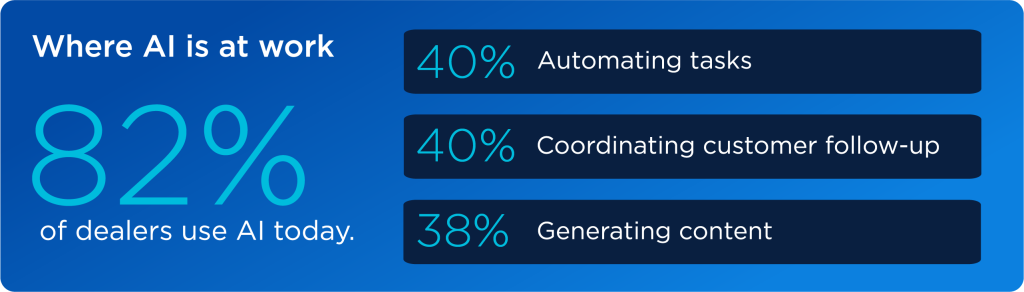
The study found that 82% of dealers are already using AI, most commonly for customer follow-up, content generation and task automation. Yet despite widespread use, nearly half of dealers say they feel behind their peers in AI adoption.
That disconnect reveals an important truth about today’s AI landscape: Adoption is no longer the challenge. Confidence is.
Only a small percentage of dealers view themselves as true AI leaders, while many feel they’re struggling to keep pace with an innovation cycle that seems to accelerate by the week.
It’s reminiscent of the internet’s early days. The dealerships that ultimately succeeded weren’t necessarily the first to build websites. They were the ones that figured out how digital tools could strengthen the everyday operation of their business.
The Real Gap Is Between Expectations and Results
One of the most striking findings in the tracker is the difference between what dealers expected AI to deliver and what they have actually experienced.
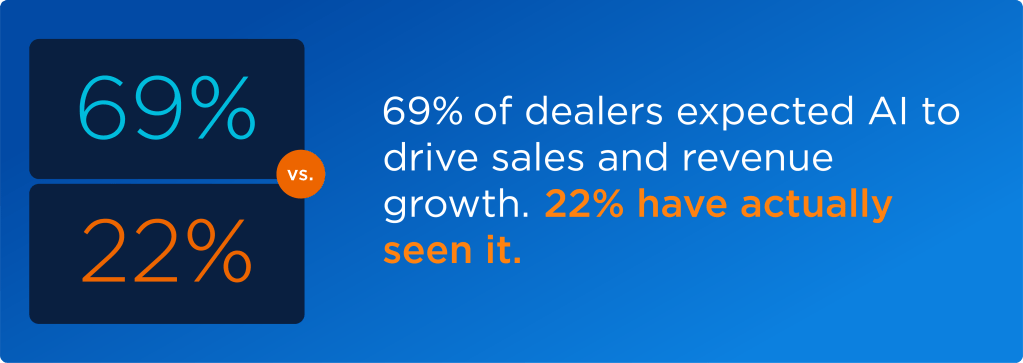
Among dealers leveraging AI, 69% expected AI to drive sales and revenue growth. Only 22% say they have seen those outcomes so far. Similar gaps exist around profitability, lead quality and lead conversion performance.
That doesn’t mean AI isn’t working.
In many cases, dealers are experiencing benefits through efficiency gains and productivity improvements rather than dramatic revenue increases. The technology may be helping teams work smarter today, even if its long-term financial impact is still emerging.
Consumers May Be Moving Faster Than Dealers
While dealers continue to evaluate AI’s business impact, consumers are already incorporating it into their shopping journey.
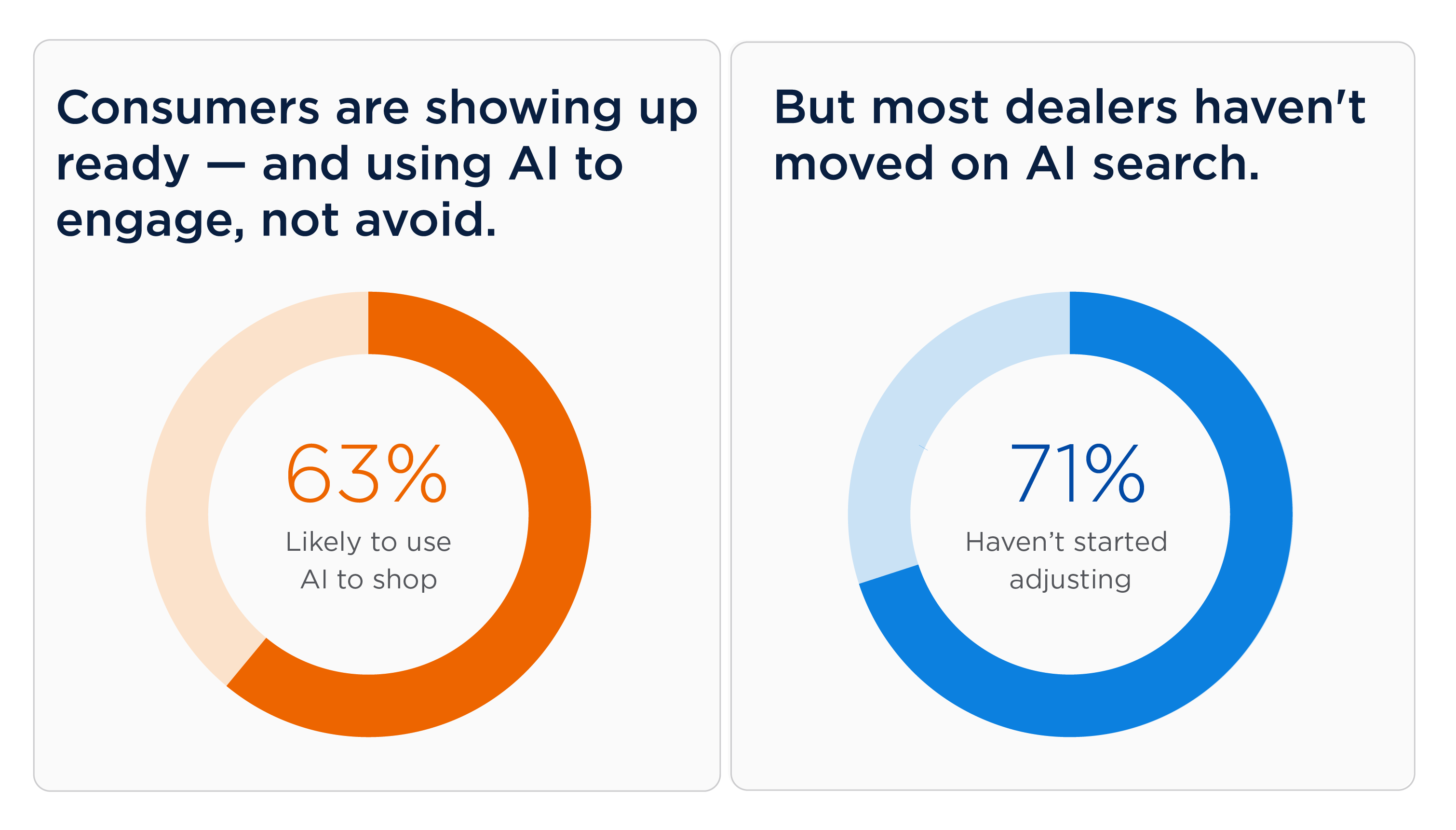
According to the study, 63% of in-market vehicle shoppers say they definitely or probably will use AI during their next vehicle purchase process. AI tools are now approaching parity with automotive shopping sites as a vehicle research source.
Importantly, consumers are not using AI to avoid dealerships.
Avoiding dealer interactions ranked among the least-cited reasons for using AI during the shopping process. Instead, shoppers report using AI to research vehicles, generate questions and arrive better prepared for conversations with dealership staff.
Just as internet-enabled shoppers arrived with more information about inventory and pricing, AI-enabled shoppers are arriving with more context and more informed questions.
The opportunity for dealers isn’t to compete with AI. It’s to be ready for the customer AI is helping create.
Winning May Depend More on Process Than Technology
The tracker also highlights a common pattern among higher-performing dealerships: They aren’t navigating AI alone.
Dealers working with external AI partners are significantly more likely to report optimal use of AI, greater confidence in outputs and stronger business outcomes. At the same time, many dealerships are relying on internal AI champions in sales and marketing to drive adoption and education across the organization.
That finding reinforces a broader theme throughout the research.
The dealers pulling ahead aren’t separating AI from the rest of the business. They’re integrating it into existing workflows, customer experiences and operational processes.
The Bigger Picture
The lesson from the internet era wasn’t that technology alone created winners and losers. It was that successful dealers learned how to apply technology in ways that improved the fundamentals of their business.
The first wave of the AI in Auto Retail Tracker suggests the same may be true today.
AI is becoming increasingly important. But the dealerships creating the most value aren’t focused on AI for AI’s sake. They’re focused on serving customers better, operating more efficiently and making smarter business decisions, with AI becoming one more tool that helps them get there.
Explore More
Source: Cox Automotive AI in Auto Retail Tracker. Total dealers: Q1 n=504, Q2 n=483. Fielded March 2026 (Q1) and May 2026 (Q2)