The electrified vehicle story in the first half of 2026 is increasingly a story about hybrids. While the overall U.S. new-vehicle market is expected to decline by 2.2% compared to a year ago, according to Kelley Blue Book counts, hybrid sales are forecast to increase by approximately 9%.
Elevated gas prices continue to support demand for fuel-efficient vehicles, and automakers are expanding hybrid offerings across more product lines. In some cases, nameplates that once offered traditional gasoline powertrains are now available exclusively as hybrids, helping drive continued growth in the segment.
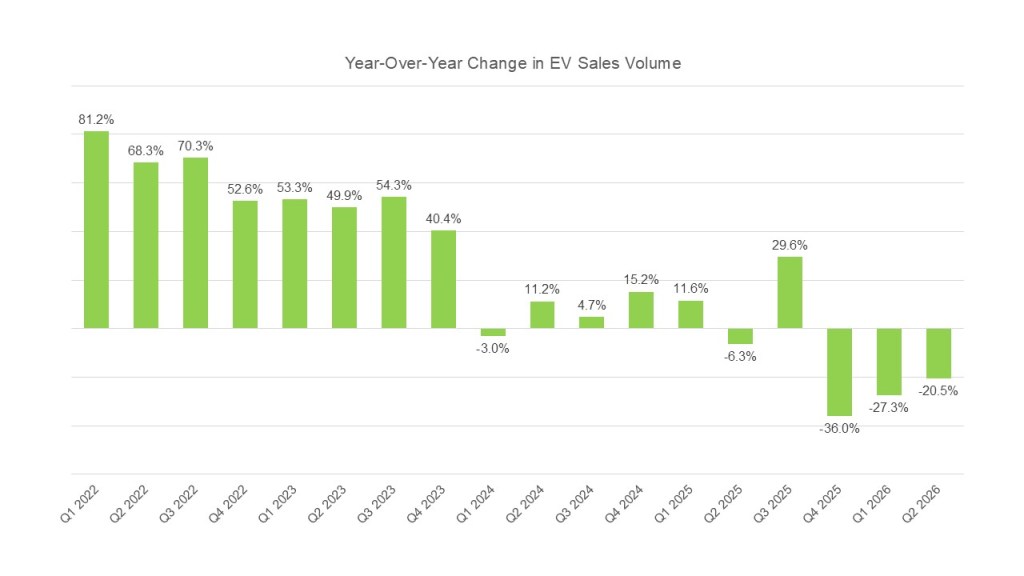
The electric vehicle story is different. According to Kelley Blue Book estimates, 247,226 EVs were sold in the second quarter, up 14.7% from the revised Q1 total. That’s the good news. The other side of the story: Q2 volume was down sharply year over year for a third consecutive quarter, declining by 20.5% from the same period in 2025.
The decline remains significant, but there is good news here as well: The Q2 sales decline was an improvement over Q1, when sales fell 27.3%,and far better than Q4 2025, when sales were down sharply as expected, off by more than 36% year over year. Sales performance in Q2 suggests the market may be stabilizing after the sharp correction.
A majority of automakers reported lower EV sales in the second quarter as manufacturers continue to reassess product plans and investment strategies. Despite softer demand, Tesla remains the clear leader in the U.S. EV market. Tesla sales were off more than 10% in the first half of the year, but the company still accounted for roughly half of all EV sales in the United States, driven almost exclusively by two products, the Model Y and Model 3.
Chevrolet was a distant second, followed by Hyundai and Cadillac. Toyota and Subaru were among the standout performers: Both brands doubling their EV volume year over year. Toyota, in particular, has emerged as an increasingly significant player and now ranks among the top five EV sellers in the U.S. market.
EV sales accounted for approximately 5.8% of total new-vehicle volume in the second quarter, essentially unchanged from the first quarter but well below the record 10.6% share achieved in the third quarter of 2025 when buyers rushed to take advantage of expiring government incentives.
The market now appears to be stabilizing after the anticipated correction. New product launches, state-level incentive programs, and continued consumer interest are helping support demand. While the market is smaller than it was, Cox Automotive continues to believe the long-term trajectory for EV adoption remains positive. As Stephanie Valdez Streaty, director of Industry Insights at Cox Automotive notes, “The next phase of EV growth will likely be driven not only by advances in the technology itself, but by how effectively automakers translate those advances into products that meet consumer expectations for affordability, utility, performance, and ownership experience.”