Consumers are increasingly relying on AI search and other AI-powered experiences to research dealerships, compare options and form opinions before ever visiting a showroom. Matt Maher and Tessa Nadik discuss how AI is changing the way trust is earned in automotive retail, from reputation and transparency to customer experience and digital presence. Learn what dealership leaders should prioritize as AI becomes a greater influence on purchase decisions.
Episode Transcript
Introduction
TESSA: Customers, they’re gonna walk into your dealership and they’ve already done their homework, right? They’ve searched your dealership, they’ve read your reviews, they’ve compared your pricing, and the question isn’t really like whether this is happening, it’s whether they find what you want them to find, and is it accurate and consistent enough for them to actually trust you before they ever even walk through the door.
MATT: Hello and welcome to Driving Impact. I’m your host Matt Maher and I am back with one of my favorite guests on the show, Tessa Nadik. Tessa, how are you doing today?
TESSA: I am doing well. Super excited to be back here. Always love having a conversation with you, Matt.
MATT: Same. Well, last time when we had our conversation, you know we talked about how dealers were showing up in AI Search. And today I think we should go a level deeper. I want to go into: once AI finds you and it starts making a judgment call about you, and what that evaluation actually means. So are are you down with going a level deeper into what these implications are?
TESSA: That’s my favorite thing is like let’s really get into those details and have a good time.
LIGHTNING ROUND
MATT: Question number one: AI is mystery shopping dealerships right now. Are most dealers even aware of this?
TESSA: Not at all.
MATT: Number two: One thing a dealer could fix this week that would immediately change how AI scores them.
TESSA: Responding to reviews both positive and negative.
MATT: The content mistake that actively hurts dealers in AI search.
TESSA: Focusing on quantity over quality and thinking that just because we have tools like Claude or ChatGPT that they can generate content and it’s going to be just as good without specialized tools or insights.
MATT: Okay, next one actually calls back another one. Responding to negative reviews, does it actually move the needle with AI engines?
TESSA: 100%.
MATT: Ooh, all right, we gotta get people uncomfortable now. The AI search feature dealers should be testing right now.
TESSA: Checking how they show up in Google’s AI overviews, not to be confused with AI mode.
MATT: Oh, we’re gonna have to dig into that one later, but there’s no time. Share of visibility. What does that mean in plain English?
TESSA: How often you show up in experiences like ChatGPT, Google’s AI overviews, AI mode versus your competitive set.
MATT: Did it again, Tessa. You survived yet another lightning round with fantastic answers.
STATS CHECK
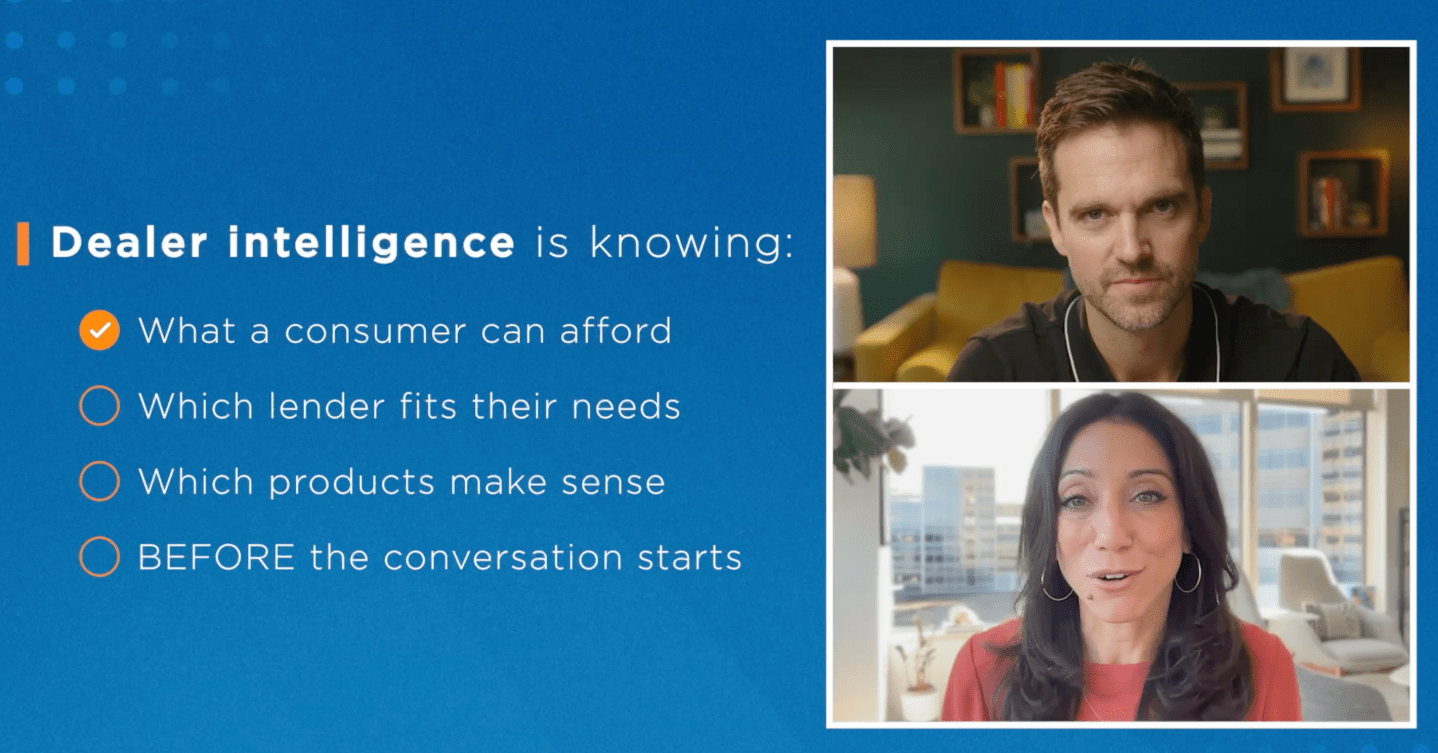
MATT: So, Tessa, I pulled a stat from Cox Automotive. 63% of in-market shoppers say they’ll likely use an AI on their next vehicle purchase, not to skip the dealership, but to show up better prepared. What’s your take?
TESSA: First, I want to say that I think that is actually underestimated, and that’s not because the data is wrong. I think that’s because there are many AI experiences. Again, Google AI overviews being one of them, where consumers are part of that AI journey and they don’t even realize it, right? There are some when it’s very intentful when they’re using an experience like ChatGPT, but like experiences like Google, again, they’re bringing that in without you actually having to opt into that. So, that is first and foremost. Kind of the message behind the noise is that it’s important to recognize that now the fact that consumers, customers, they’re going to walk into your dealership tomorrow and they’ve already done their homework, right? They’ve searched your dealership, they’ve read your reviews, they’ve compared your pricing, and the question isn’t really like whether this is happening. It’s whether they find what you want them to find, and is it accurate and consistent enough for them to actually trust you before they ever even walk through the door.
MATT: Definitely, and it’s information asymmetry in a way. They walk in and you don’t know what they believe about you, right? That that’s the trickiest part. It’s like how do you corroborate what is actually ground truth at the dealership?
TESSA: Right. I think even one step down is the fact that if they don’t see you or how you show up and if you’re not tracking that, like that doesn’t show up in a dashboard. So you have to be very hyper vigilant in this area.
AI SEARCH AUDIT
MATT: The amazing thing about that statistic is with a tool that didn’t exist a few years ago. A majority of people are now using this tool to discover dealerships. So, like at its baseline level, Tessa, like what is actually happening right now?
TESSA: Yeah, this is a real broad shift in how consumers and the tools they use are evaluating dealerships before they ever even make contact, right? So the dealers that are doing well in the space, like they’re not waiting for a report or someone to reach out about their score. They’re actively managing what AI finds when it looks for them.
MATT: Is AI scraping everything? Like do you have to basically… no stone left uncovered in terms of what your digital footprint is online? What’s your strategy there and how they navigate that?
TESSA: Yeah, I mean pretty much the answer is yes. It’s looking at everything that’s available out there, right? Whether that’s reviews, the content you’ve published, things that people have written about you, social, all of those aspects to really understand again like who you are or who your dealership is as is as an entity as a being, right? So the goal isn’t really like let’s just have a five-star review. It’s hey it’s okay maybe that we’re a four and a half star, a four-star, but are you engaging with your customers who had something both positive and negative to say? Are you showing up in the way that there is enough information that the AI agents can bring that information back to the consumer? If you’re not doing that, or they can’t find information that they feel confident in, either they’re not going to recommend you or when people are asking about you specifically, they’re gonna have to try to make something up. That’s the reality of probabilistic engines, right?
MATT: Okay, let me run this scenario for you. You’re a dealership. You get some wonderkin out of MIT to come in and you know they’re building agents. They’re doing everything you could possibly do to make sure you’re showing up right in GPT. You’re showing up exactly how you want to in AI overviews. Everything that they believe they can do to optimize, optimize, optimize for AI models and large language models. The question now is: Can you do everything right, and AI still gets information about your dealership wrong?
TESSA: Honestly, yes. AI systems, they make mistakes. They can pull outdated information. They can misread context. But the dealers who are kind of ahead of this, like they’re not just improving their profiles, right, or doing the things they need to do just to check a box. They’re actively monitoring what AI is saying about them, so that if it has something wrong or something shows up inconsistently, they can address it head on. If you see consistently someone is asking a question about your dealership, let’s just go with the hours, right? And if you’re monitoring this or working with a partner that monitors those types of queries for you, and it’s saying that your dealership is open from 7 to 3 and really you’re a 9 to 5, you can take active steps to figuring out like a) where that information came from, right? And is it something a property you own and control to make updates. In the case that it’s not, that’s nothing new, right? In SEO, there’s a lot of things we talked about. Well, we could reach out to the webmaster and ask him to do X, Y, and Z. That’s not necessary, right? I mean, it should be for consistency, but like maybe you publish some more information on your dealership group website that says like these are the hours, and again, it’s going to look at your domain and pull that information in. So, again, there are times where it can get it wrong, and it doesn’t mean that there’s nothing that you can do about it or it’s out of your control, but in order to know that, you got to be looking at it, right? Or again, partnering with someone who’s keeping an eye on that for you.
MATT: So, if I’m a dealership, it used to be easier with SEO and even in the beginning of AI first search, because you’re it’s about visibility, right? Have other dealerships come to my dealership. Once you come into, you know, the walls of our dealership, then I control the narrative and I can convince you. But it sounds like it has evolved from that, that now these dealerships are being evaluated on scoring systems, that most like, they might not even know these exist. So does this evolve beyond just a visibility issue at this point?
TESSA: Yeah, I think it does, right? Again, it also plays heavily into the consumer experience and like so these AI agents they’re coming out to score you on like whether you’re being transparent about your prices. Like that directly correlates to like how consumers experience your dealership when they show up, right? And the reality is like I think that’s a good thing. Again, it’s holding us all accountable at a much different level than I think we’ve ever had to historically. And the reality is like not just focusing on the things that seem black and white, so like reviews and responding to things you might see on Reddit and making sure that you have a good content strategy that answers your customers’ questions, but also again being consistent in a way that we expect. I think humans by default, we want consistency and accuracy and again, if we can’t find that with the platform that we’re landing on. We’re gonna go find it somewhere else.
MATT: Okay, Tessa, this is a complicated one, but you’re probably one of the only people that can answer this. I know if I go to ChatGPT and I say, “Tell me why Matt’s dealership is the best dealership in New York,” it’s gonna probably give me reasons to reinforce why it’s the best. But if I say, “Tell me why Matt’s dealership is terrible and has five bad reviews,” it’s gonna give me really negative sentiment. It’s almost like a mirror. So this is a dumb question, but I think it’s actually so important. How do you get real ground truth? Like, what should you be asking to actually understand where that information is? And then, how would you also, as a second part, deal with someone who might ask a leading question like that and either get a positive or negative sentiment that might not be true?
TESSA: Yeah, how do you know for sure what the ground truth is? Reality is you don’t. Okay. You’re not going to go to ChatGPT and say, “Is Matt’s dealership the best dealership in town?” and probably get a correct answer. It’s gonna say it’s likely gonna say yes because of the sentiment that it’s reading in your voice? These engines are meant to give you something that you want to hear right so when you think about that it is gonna mirror whatever your tone is and we as consumers don’t filter ourselves to be objective when we’re asking questions. So again, try to look at it in multiple angles. If you are interested in Matt’s dealership down the street, ask “what are the positive things that people say?” And in your next prompt, feel free to ask “what are the negative things?” Because the reality is about consumer behavior is it’s not nailing the first prompt that someone asks. This is a conversation. That’s where you need to pay attention. It’s not a one size fits all, like when you used to go to Google, and still some people do, and say “Ford F-150s for sale near me” and click a link and get to a result. No, they’re exchanging eight, nine, ten times to get that information. You gotta be aware of the fact that it is directional to give you an understanding of areas that you need to improve. It is not meant to be a direct, scientific, 100%, every time someone asks this question, they’re going to get this answer. So, not a dumb question at all, Matt. But again, we like certainty, as we talked about earlier, as humans. And like this is not a time where things are certain. You’re going to see some variability and use it, in a way to improve the experience for LLMs, but also improve it for your consumers. And you’re going to be on the right track.
MATT: And there’s no silver bullet. It’s not like you can game this system or use this tool or this one thing. To your point, this isn’t that one-shot search where it’s like the one query comes into an LLM and boom, it’s everything I ever wished it to say about me. It’s deeper in these contextual conversations.
TESSA: Yes.
MATT: Which makes it sound like it’s everything around your dealership, it’s like you, you should run a great dealership and have great customer service and do all these things. And if you do that right, it ideally will start to surface, right? Because it’s finding these in-between moments, not what you’re telling them to essentially look at.
TESSA: Yeah, and you know. What you just said, yes, is exactly what I was trying to get across. And again, we live at a time where even if you are the best dealership though, it’s a little bit of a “yes and.” So let’s say that you’re the best dealership, but you have no online presence, like what is the likelihood that you’re just gonna you know continue to be successful on word of mouth and so on? You might be the best with consumers, but you do have to consider what do LLMs say about you? And if you don’t have a good digital presence or you’re not leaning into reputation management or those items, you’re going to get passed by. And that’s never going to show up in a dashboard if you’re not measuring it. Work with people in different…whether you know you want to use your agency or whatever, it is to to help you understand this, because it is complicated, right? You asked like what is the easiest way, and the answer is there’s a bunch of different ways you can get insights and understanding, but that can be overwhelming too, so really look at who you’re partnering with, what tools are they using. Are they using more than one to give you a more healthy understanding, not just what shows up on your domain, but what is happening around you that is influencing how consumers feel about you. That is likely coming from experiences they’re having in in AI search.
MATT: So last question here, because I think we’ve really hit the spectrum of all the possibilities, but I want to bring this back down to be really practical because I think it can just be overwhelming a lot because there’s so much that you could actually do, that you often say “where do I start?” So I want to flip that to you to say if there was one thing a dealership could do this week, one thing they could do to start to get the car in the right direction?
TESSA: I want to say this first. Put your dealership name in because if you don’t show up or it has bad things to say about you, that’s huge. That’s a huge red flag to start. Check your brand. Don’t take it for granted and think that you’re just showing up there or you’re showing up positively.
MATT: Great point.
TESSA: But don’t panic if you see something you don’t like. Run it a couple times. Put a plan together. These are things that can be addressed and again it’s not the end of the world. Nobody’s perfect and we all have opportunities to improve. And once you get it right, that doesn’t mean it’s the end of it. So let’s say everything is positive and then you go through a little bit of a rough patch and you’re seeing like the answers shift to be a little bit more in a negative sentiment. What can you do to alleviate some of that or respond to it and show that you’re working on it, that you care? Consumer satisfaction, consumer experience is absolutely everything. So if you look at it through the lens of what would be the right thing to do for the customer or for the consumer, you’re likely going to win in the AI space as well.
FINAL WORD
MATT: Every dealer watching has a reputation in AI search that they’ve probably never looked at. So the final word for you is trust signals.
TESSA: There’s a lot of things that we talked about today. Trust, I would say is one of the most important things to be leaning into, right? Because anything that AI is using to recommend you, whether that’s reviews, pricing consistency, response time, content accuracy, every dealership is constantly sending these signals to AI, whether they are managing them or realize it at all. The difference between, I think, the dealers that are showing up in AI recommendations and the ones who aren’t isn’t really about their marketing spend, because we don’t exist in a space where you can pay to play and make yourself up to the top. Not yet, anyway. So you have to really earn this, and that means that you have to lean in, right? You have to be considerate of the fact that there has to be information for these AI experiences to pull. I think it was either Claude or ChatGPT actually tested out, returning like “I can’t find the information” or “I don’t know” and us, as consumers, we didn’t like that. We said “do whatever it takes to get us an answer.” So remember that. So it’s going to find an answer whether you have one out there and you’re managing it or not.
MATT: Thank you so much. Usually the sequel is never as good as the original, but dare I say, this was The Empire Strikes Back. You gave us a new hope, and now we had a fantastic second episode. So I just want to thank you so much for your time. And can’t wait to see you in Atlanta again soon.
TESSA: Yeah, absolutely. Always a pleasure.